

Navigating the Mobile App Development Landscape in 2025
- By William Smith
- 28-07-2025
- Mobile App Development
In 2025, the world of mobile app development continues to evolve at a rapid pace, shaping how businesses operate, interact with customers, and deliver value. As smartphones and digital technologies become even more embedded in daily life, mobile applications are no longer a luxury—they’re a strategic necessity. From AI integration to 5G optimization, the mobile app development landscape in 2025 offers both immense opportunities and complex challenges.
Whether you're a business owner, developer, or tech entrepreneur, understanding how to navigate this shifting terrain is key to staying competitive. In this comprehensive guide, we explore the major forces shaping mobile app development in 2025, key trends, tools, and strategies for building successful apps in a crowded marketplace.
Understanding Mobile App Development in 2025
Mobile app development refers to the process of designing, building, testing, and maintaining software applications specifically for mobile devices such as smartphones and tablets. In 2025, the scope of mobile app development has expanded beyond traditional platforms (Android and iOS) to include wearables, foldable devices, smart TVs, and even embedded systems in vehicles.
The development process includes frontend and backend development, UI/UX design, API integration, cloud services, and security protocols. Developers now need to be proficient in a variety of frameworks and tools to deliver seamless, high-performing applications across devices.
Key Trends Shaping Mobile App Development in 2025
To navigate the mobile app development landscape effectively, it’s crucial to understand the trends that are influencing the market.
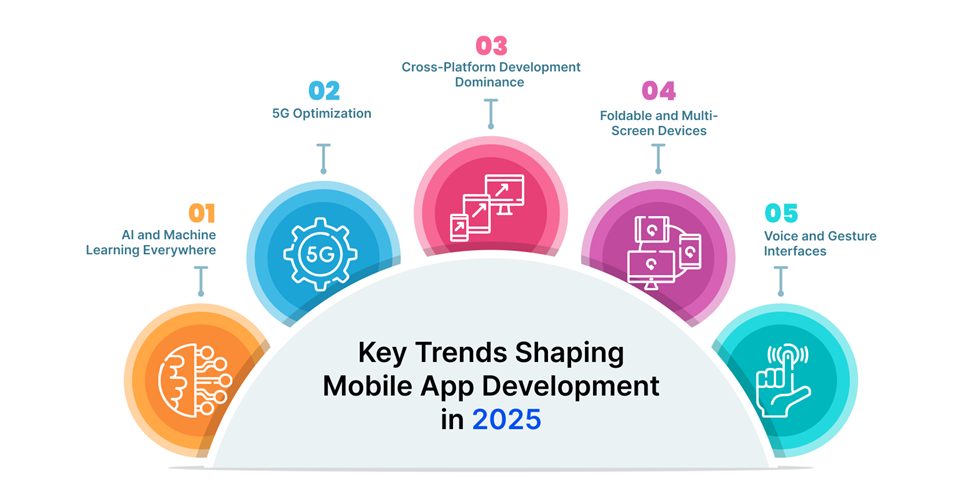
1. AI and Machine Learning Everywhere
AI is no longer optional in app development. From predictive search to chatbots and personalization engines, AI is integrated into nearly every modern app. Developers are increasingly using platforms like TensorFlow Lite and Core ML to bring intelligent features directly into mobile apps.
2. 5G Optimization
The rollout of 5G has dramatically improved mobile internet speeds and reduced latency, opening new doors for real-time apps like augmented reality (AR), virtual reality (VR), live streaming, and cloud-based gaming. Mobile app development in 2025 focuses heavily on leveraging 5G to enhance user experiences.
3. Cross-Platform Development Dominance
Frameworks like Flutter, React Native, and Kotlin Multiplatform are now preferred for building cross-platform apps. These tools allow developers to write once and deploy everywhere, cutting costs and speeding up time to market. Cross-platform mobile app development is especially popular among startups and SMBs.
4. Foldable and Multi-Screen Devices
Foldable phones and multi-screen devices are no longer novelties. Developers must now consider adaptive layouts, fluid UIs, and responsive design when working on mobile app development projects. These devices demand flexible apps that transition smoothly between screen configurations.
5. Voice and Gesture Interfaces
Voice assistants like Siri, Google Assistant, and Alexa have normalized voice-controlled interfaces. Gesture-based navigation and facial recognition have also become part of everyday mobile interactions. Mobile app development in 2025 increasingly supports these input types to improve accessibility and engagement.
The Mobile App Development Lifecycle
To successfully build a mobile application, developers follow a structured lifecycle that guides the project from conception to deployment and maintenance.
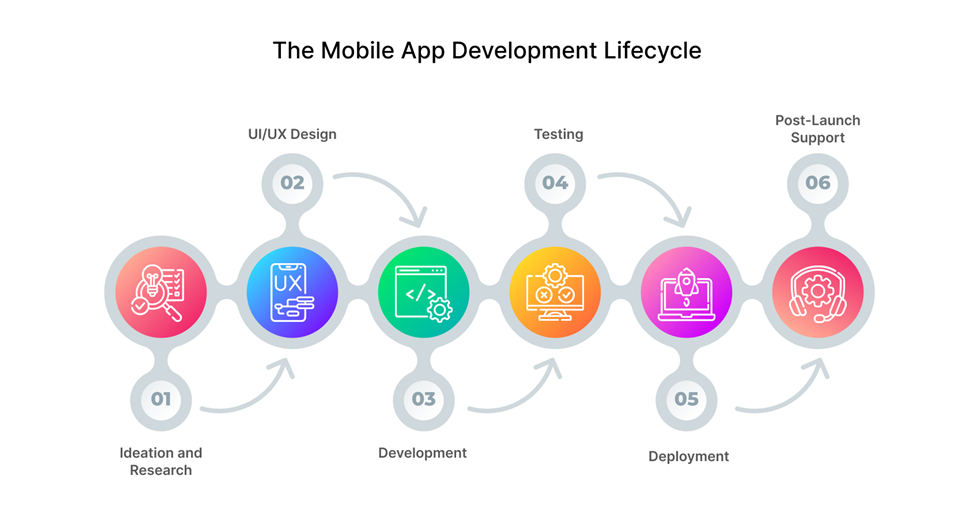
1. Ideation and Research
Start by defining the app’s purpose, target users, and core features. A detailed problem-solution framework helps shape the vision. Conduct market research, competitor analysis, and user surveys to identify unmet needs and validate your app concept. This stage also includes creating user personas and outlining the unique value proposition (UVP). A clear business model and monetisation strategy (ads, freemium, subscriptions) should also be outlined here.
2. UI/UX Design
User experience is central to an app’s success. In 2025, design trends favour minimalist layouts, dark mode, microinteractions, voice-enabled navigation, and AI-driven personalisation. Tools like Figma, Adobe XD, and Sketch support wireframing, prototyping, and collaborative feedback loops. The goal is to ensure intuitive navigation, accessibility, and visual appeal. Design systems and style guides are often created at this stage to ensure consistency.
3. Development
Development involves selecting the appropriate technology stack based on the app’s goals, budget, and timeline. Here’s a quick look at platform options:
- Native Development: Swift for iOS, Kotlin for Android – Offers the best performance and access to device features.
- Cross-platform Development: Flutter, React Native, Xamarin – Enables faster deployment across iOS and Android with shared codebases.
- Progressive Web Apps (PWAs): Built with HTML, CSS, JavaScript – Suitable for web-first experiences with mobile responsiveness.
Key considerations include API integrations, database design, backend development, and cloud service integration (e.g. Firebase, AWS, Azure).
4. Testing
Quality assurance is essential in modern mobile app development. Testing covers:
- Functional testing: Ensures core features work as intended
- Performance testing: Checks responsiveness and load handling
- Security testing: Validates data privacy and secure transactions
- User testing: Gathers feedback from real users to identify UX issues
Automated testing, unit testing, and manual testing are often combined. Tools like Appium, Espresso, XCUITest, and TestFlight support robust QA processes. Crash reporting and log tracking are also configured at this stage.
5. Deployment
Publishing your app involves submitting it to app stores (Google Play, Apple App Store) and adhering to platform-specific guidelines for security, content policies, and user data management. Key steps include:
- App Store Optimisation (ASO): Optimise title, keywords, visuals, and descriptions to increase visibility.
- Version control: Tagging stable builds and managing update rollouts.
- Release notes: Communicate new features or bug fixes to users.
- Staged rollouts: Gradually release the app to reduce the impact of potential issues.
6. Post-Launch Support
Ongoing support is crucial to maintaining user engagement and satisfaction. This phase includes:
- Monitoring performance using tools like Firebase Analytics, Mixpanel, and Google Analytics for Mobile
- Collecting user feedback through reviews, in-app surveys, and support tickets
- Regular updates for bug fixes, new features, and OS compatibility
- Marketing efforts such as push notifications, social media promotions, and in-app campaigns help boost retention
- User segmentation and personalisation to improve experience and engagement rates
Incorporating user data into your product roadmap ensures your app evolves based on real user needs.
Choosing the Right Tech Stack
In mobile app development, choosing the right tech stack influences performance, scalability, and cost. Here are some popular tools and languages used in 2025:
- Frontend: Flutter (Dart), React Native (JavaScript), SwiftUI, Jetpack Compose
- Backend: Node.js, Firebase, AWS Amplify, GraphQL
- Databases: MongoDB, PostgreSQL, Realm
- APIs: RESTful APIs, GraphQL, third-party SDKs
- CI/CD: Jenkins, Bitrise, GitHub Actions
Security in Mobile App Development
With increasing concerns about data privacy, mobile app development in 2025 emphasizes strong security measures. This includes:
- End-to-end encryption
- Biometric authentication
- Secure data storage (using Keychain or Keystore)
- Regular security audits and penetration testing
- GDPR and CCPA compliance
Failure to implement security best practices can result in user distrust and legal liabilities.
Common Challenges in Mobile App Development
While the mobile ecosystem is thriving, developers face several hurdles:
1. Device Fragmentation
Developing apps that work flawlessly across a variety of devices, screen sizes, and operating system versions is one of the most persistent challenges in mobile app development. Manufacturers frequently release new models with different hardware configurations, and not all users update to the latest OS version. This requires extensive compatibility testing, responsive design, and sometimes maintaining multiple code branches. Developers must also optimise for diverse chipsets, camera specs, and network capabilities, especially in Android’s highly fragmented ecosystem.
2. Performance Optimisation
Mobile users expect apps to be fast, responsive, and lightweight. Optimising for speed, battery consumption, memory usage, and offline capabilities is essential. Poor performance often leads to user abandonment and negative reviews. Developers use techniques like lazy loading, caching, code minification, and background task scheduling to maintain optimal performance. With growing emphasis on low-end and mid-range device users, efficient resource management is more critical than ever.
3. App Store Regulations
Getting your app approved by the Apple App Store or Google Play Store involves navigating strict and constantly evolving policies. Common issues include privacy concerns, content violations, in-app purchase rules, and data handling practices. Frequent rejections due to unclear guidelines can delay product launches and increase development time. Developers must stay up to date with compliance requirements such as App Tracking Transparency (ATT), GDPR, and Play Store policy updates to avoid penalties or bans.
4. User Retention
Downloads alone don’t guarantee success. Keeping users engaged over time is key to an app’s growth. Developers must implement strong onboarding experiences, personalised push notifications, and engagement strategies like rewards, in-app messages, and gamification. Churn rate remains a major concern in competitive markets. Regular updates, collecting feedback, and providing value through continuous innovation help improve user lifetime value (LTV) and reduce uninstalls.
Best Practices for Successful Mobile App Development
To ensure your mobile app development project succeeds in 2025, consider these proven strategies:
1. Start with an MVP (Minimum Viable Product)
Launch a Minimum Viable Product to test your app idea with real users and validate its core features. An MVP allows you to gather early feedback, identify market demand, and iterate quickly without over-investing time and money. Focus on delivering just enough functionality to solve the main user problem. This agile approach reduces risk and speeds up your time-to-market.
2. Prioritise User Experience (UX)
An intuitive, seamless user experience is critical to app adoption and retention. Design with user-first principles, focusing on easy navigation, clean interfaces, and fast load times. Consider accessibility features like voice commands, screen readers, and colour contrast to make your app inclusive. In 2025, incorporating personalised UI, gesture-based interactions, and microinteractions is key to staying competitive.
3. Use Analytics for Data-Driven Decisions
Implement analytics tools such as Firebase, Mixpanel, or Amplitude to track user behaviour, feature usage, and conversion funnels. These insights help you identify pain points, prioritise improvements, and validate feature performance. Make sure to monitor KPIs like retention rate, session length, active users, and in-app purchases to make data-informed updates and business decisions.
4. Continuous Updates and Iteration
Mobile apps are not one-time projects. Regularly releasing bug fixes, performance enhancements, and new features shows commitment to your users and encourages loyalty. Stay responsive to user reviews and rapidly adapt to OS updates or device changes. Adopt a feedback loop where each release learns from real-world usage and delivers better value.
5. Plan for Scalability from the Start
As your user base grows, your app should be able to handle increased traffic and demand without performance degradation. Choose a scalable backend infrastructure—such as cloud services (e.g., Firebase, AWS, Azure)—and design with modular architecture to support future expansions. Scalability ensures your app can grow smoothly without the need for complete overhauls later.
Future Outlook: What’s Next in Mobile App Development?
The future of mobile app development is dynamic, fast-evolving, and full of transformative potential. Developers must stay agile and forward-thinking to remain competitive. Here are key innovations shaping the next era of mobile apps:
1. 6G-Ready Apps for Ultra-Fast Connectivity
With 6G technology on the horizon, mobile apps will benefit from unprecedented speed, bandwidth, and low latency. This will enable real-time 8K streaming, instant cloud-based processing, and ultra-responsive AR/VR experiences. Developers will need to optimise for edge computing and data-heavy applications that leverage this hyper-connectivity.
2. Spatial Computing and Mixed Reality Experiences
Mobile apps are moving beyond flat screens. Spatial computing blends augmented reality (AR), virtual reality (VR), and AI to create immersive, context-aware experiences. With platforms like Apple Vision Pro and Meta Quest, apps for virtual collaboration, 3D navigation, interactive learning, and AR retail will become mainstream. Designing intuitive, motion-based UX will be crucial in this space.
3. AI-Generated Code and Low-Code Platforms
The rise of AI-powered development tools and low-code/no-code platforms is revolutionising how apps are built. Developers can now automate repetitive tasks, generate boilerplate code, and even design UIs using natural language. This shift allows for faster prototyping, cost savings, and greater accessibility for non-technical creators. Tools like GitHub Copilot, FlutterFlow, and OutSystems are leading the charge.
4. Decentralised Apps (dApps) Using Blockchain
Blockchain technology is paving the way for decentralised apps (dApps) that operate without central servers, offering enhanced security, transparency, and user ownership. These apps are especially popular in finance (DeFi), gaming, and identity management. Developers must learn smart contract platforms like Ethereum, Solana, and Polygon to build in this trustless ecosystem.
Conclusion
Navigating the mobile app development landscape in 2025 requires not only technical skills but also strategic insight into trends, user expectations, and the tools of the trade. With the rise of AI, 5G, and cross-platform frameworks, developers are better equipped than ever to build innovative and impactful apps.
Businesses that embrace these changes and invest in smart, scalable mobile app development will lead the way into the next digital era. Whether you're building your first app or refining an existing one, understanding this ever-changing landscape is key to success.
Author

William Smith
This blog is published by William Smith.
Recent blog
.jpg)
Role of DEX Development in Decentralized Finance
Technology | 24-09-2026.jpg)
How to Evaluate Outsourced Link Building Without SEO Risk
SEO | 23-09-2026.jpg)
Optimize Salesforce Data Before Deploying AI Agents
Salesforce | 22-09-2026