Web Testing for E-Commerce: A Complete Guide to Success
- By Kanika Vatsyayan
- 04-04-2025
- E-commerce
In today's digital age, e-commerce has become the backbone of retail. The standard for offering effortless online shopping has changed into an essential business requirement that drives success. Every profitable e-commerce platform continues to grow with a well-designed web testing strategy at its core. Web testing services following a strict protocol result in exceptional user navigation, safe payment systems, and flawless system operations on all devices. Lack of business web testing leads to decreased sales combined with dissatisfied customers as well as degraded company reputation.
This comprehensive guide presents an outline to guarantee excellent user experiences through e-commerce web testing practices.
Why Web Testing Services are Crucial for E-commerce
Online retail websites utilize complex systems to handle product databases alongside accounts for users and payment processing and delivery management features. All system elements need perfect synchronization to maintain continuous consumer operations. Web testing functions as an essential quality assurance tool that finds and solves errors which users will encounter before they happen. Its importance stems from this factor.
- Improved User Experience: A positive user experience stands as the key factor to acquire new clients and keep existing ones. Web testing demonstrates that websites deliver an efficient loading speed and intuitive interface and streamlined checkout process. The website converts more customers effectively while delivering better customer satisfaction.
- Enhanced Security: E-commerce systems need to protect sensitive information consisting of credit card data and personal addresses of users. Web testing stands as an indispensable factor to locate security hazards while defending the site against external threats. The implementation of this practice builds trust while protecting both the business operations and its customer base.
- Enhanced Performance: The combination of slow site loading and website outages leads to both decreased customer satisfaction and reduced sales. Web testing helps to find performance slowdowns which leads to website speed and stability optimization. The website operates smoothly during peak traffic because of performance guarantees that ensure user responsiveness.
- Enhanced Brand Reputation: A smooth website operation with remarkable user experience leads to better brand reputation which builds customer loyalty. Your website's unreliability combined with its malfunctions can damage your company reputation which may lead to negative customer evaluations.
- Cost Reduction: Spotting and fixing bugs during website development costs less than fixing errors that appear after the website launches. Early detection of issues through web testing services helps organizations save both time and money across the development period.
Types of Web Testing for E-commerce
Web testing services for e-commerce businesses necessitate several testing methodologies that evaluate distinct operational facets and performance attributes of the website. These are as follows:
Functional Testing
This testing method verifies that each website feature functions in accordance with specifications. Web testing services encompass evaluations of product discovery functionalities, cart item addition and checkout processes, payment gateway interface examinations, order tracking, and customer support capabilities. The website's operational operations are assessed via functional testing to ensure accurate and reliable functioning.
Usability Testing
The purpose of usability testing is to examine the user experience by assessing their interface interactions with the website structure. The test examines how users navigate through the website design along with layout elements to guarantee the interface is intuitive and user-friendly. The evaluation process of usability testing requires researchers to monitor authentic users while they utilize the website to collect their assessment of the system.
Performance Testing
Performance testing evaluates website functionality when dealing with multiple users and peak traffic moments. It enables teams to locate performance problems that allow them to maximize website speed along with stability and scalability. The testing process consists of three components: load testing, stress testing and endurance testing.
Security Testing
Online stores need security tests because they handle confidential customer information. The testing solution detects possible cyber attack entry points which include SQL injection attacks and cross-site scripting vulnerabilities and also protects against data breaches. The website undergoes security testing to establish its capabilities in protecting users from unauthorized access and data theft.
Mobile Testing
Mobile testing has become essential because mobile shopping continues to gain popularity among customers. The testing functionality verifies that e-commerce websites deliver optimal performance for mobile devices through seamless experiences on smaller screens.
Compatibility Testing
The website's correct operation across different operating systems, devices, and browsers can be achieved through compatibility testing. E-commerce websites require this testing specifically because users can access them from various devices, including desktops, laptops, tablets, and smartphones.
Automation Testing
Software tools, through automation testing services, enable the completion of repetitive testing duties, including functional and regression testing. This makes the testing process more efficient and enables testers to perform advanced testing operations.
Manual Testing
Manual testing remains essential because it maintains its value for usability testing and exploratory testing scenarios. The assessment process under manual testing depends on human testers who engage with website interfaces to give feedback about their interaction experience.
Accessibility Testing
The accessibility testing verifies that disabled users can interact with the website properly to fulfill WCAG standards. The testing process verifies screen reader functionality along with keyboard accessibility and image alternative descriptions.
Localization Testing
The website content and currency format alongside date formats and additional elements need proper adjustments for multiple languages and regional requirements through localization testing for e-commerce businesses operating in international markets.
Key Considerations for E-commerce Web Testing
The effective implementation of e-commerce web testing necessitates the formulation of an appropriate strategy. This will ensure your platform provides a seamless user experience while maintaining data security to improve both conversions and customer happiness. Below are few essential points:
Define Clear Objectives and Scope
Your web testing services require definitive testing goals before beginning. Detailed testing of which system capabilities should receive the most stringent functional tests? Which website components require special attention during usability testing since they include checkout and product browsing? When a project scope is appropriately defined, organizations can allocate resources and efforts more efficiently.
Develop a Comprehensive Test Plan
The testing process follows a detailed test plan, which serves as its navigational guide. The plan must establish testing types (functional, usability, performance, security) and methodologies (manual, automation), define timing, resource needs, and success requirements, and enable testing activities to remain methodical and well-ordered.
Prioritize Testing Efforts
E-commerce sites are complex. Prioritize testing based on criticality. The main functionalities of the shopping cart, payment gateway, and user accounts should receive testing priority. Failures in specific high-risk operational zones could have major impacts on business operations.
Select the Correct Tools and Approaches for Testing
Select appropriate tools for automation testing, performance testing, and security testing. Also, be sure to balance manual testing with automation. Manually executed tests support usability testing and exploratory testing, while automated tests speed up regression testing and repetitive work to boost operational speed.
Integrate Testing into the Development Lifecycle
Web testing should receive proper attention from the beginning of development. The testing process must begin at the early stage of development (shift-left testing). By starting bug detection early developers can resolve issues before costs escalate while saving time. The best approach for development success depends on testing activities throughout all development stages.
Realistic Test Data and Environments
The testing process requires genuine data samples which accurately reflect actual operational situations. A testing environment must be created with identical specifications to what production operates. Accurate test results and avoidance of production issues are both possible when this approach is implemented. Consult web testing specialists for expert supervision along with extensive coverage of your tests.
The Role of Web Testing Service Providers
Ensuring the quality and performance of e-commerce systems depends much on web testing service providers. They provide particular knowledge and tools that will greatly improve your testing initiatives. Here's what they bring to the table:
- Specialized Expertise and Tools: Web testing service providers maintain comprehensive expertise about different testing approaches such as functional testing alongside usability testing and performance testing along with security testing. Testing service providers maintain expertise in multiple testing tools for automation testing as part of their access to various testing resources which allows them to perform extensive and efficient testing activities.
- Comprehensive Testing Coverage: Service providers provide complete testing services which cover every part of your website including fundamental operations and rare conditions. Testing providers should create test suites which handle different user situations and support different browser types and operating systems while keeping full test range and reducing hidden bug possibilities.
- Objective Perspective: Web testing experts from outside your organization can detect problems that home-based testers often overlook because they understand the system too well. A new perspective applied to the testing process helps identify concealed issues that could affect the user experience.
- Scalability and Flexibility: The ability to expand or reduce web testing resources exists for providers who serve your project requirements. Web testing service providers enable their clients to deal with both busy testing times and changing project requirements through their flexible support model. The testing capacity can be adjusted to suit your needs without the additional costs and training requirements of new staff members.
- Cost-Effectiveness: Companies find it cheaper to outsource web testing operations rather than pay for maintaining their own internal testing staff. Testing personnel costs and management expenses are eliminated alongside the expenses for expensive testing tools when you outsource your web testing operations.
- Faster Time to Market: The testing process becomes more efficient with web testing services providers which allows you to reach the market faster. Web testing experts help organizations identify and fix bugs efficiently through their advanced testing techniques which shorten product release cycles. Web testing services allow businesses to achieve market superiority in the fast-moving e-commerce industry.
The Future of Web Testing for E-commerce
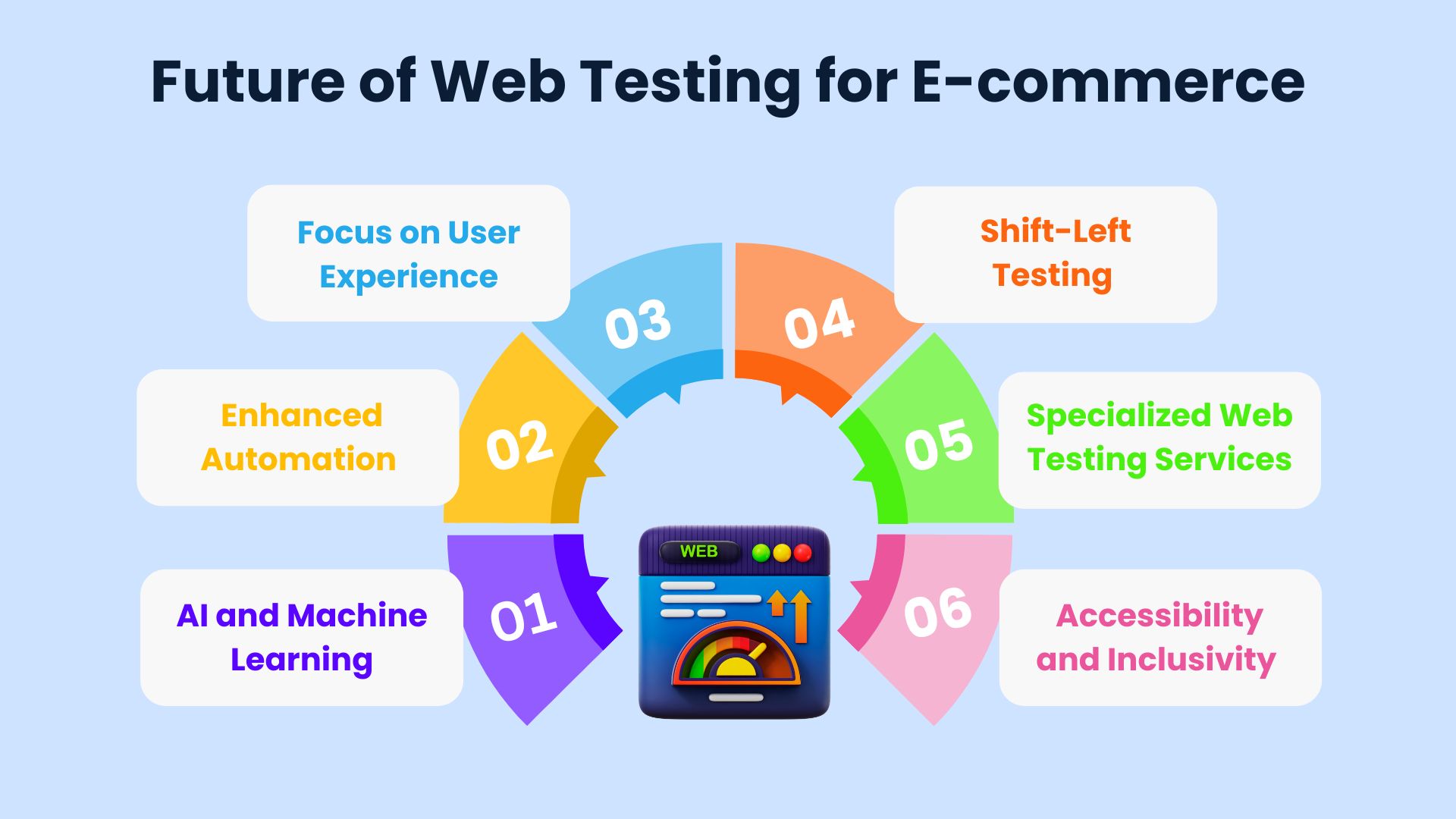
Web testing for e-commerce operates in a dynamic state because new technologies and changing user requirements drive its evolution. Web testing for e-commerce exists within an environment where multiple emerging trends influence its development:
AI and Machine Learning
AI is revolutionizing testing. The technology enables automated bug identification through predictive analysis while simultaneously producing test cases and performing automated testing. The release of human testers from mundane tasks enables them to focus on critical tasks, including usability testing and exploratory testing.
Enhanced Automation
Advanced automation testing systems will become more sophisticated, enabling them to handle complex test scenarios and fully integrate within DevOps pipelines. The combination of these improvements will create faster release cycles alongside continuous testing operations, producing rapid delivery of premium e-commerce user experiences.
Focus on User Experience
The rise of competition between companies will make user experience the determining factor for success. Customer interactions analyzed through AI analytics and user behavior data will supply enhanced understanding to redesign interfaces and tailor user experiences.
Shift-Left Testing
The practice of shift-left testing which starts testing activities at earlier phases in development processes will gain more momentum. Rapid bug detection alongside quicker resolution will happen through shift-left testing that will lower costs while delivering better quality products.
Specialized Web Testing Services
Specialized web testing service providers will experience rising demand because testing operations have become increasingly complex. Their advanced technological knowledge and methodological expertise will serve businesses that need detailed and effective testing solutions.
Accessibility and Inclusivity
The importance of accessibility and inclusivity testing will rise to maintain e-commerce platforms which serve all users regardless of disability status. E-commerce operators must follow WCAG guidelines while performing complete accessibility testing as part of their procedures.
Concluding Thoughts
The evolution of e-commerce requires seamless online experiences that lead to vendor success. Web testing services represent the essential building block to reach this goal because they guarantee that platforms function correctly. Businesses achieving superior customer satisfaction with e-commerce platforms require an integrated web testing method including functional testing alongside usability, automation and manual testing approaches.
Web testing requires continuous work beyond a single procedure because it develops into part of your regular operational cycle. Your testing efforts need constant evolution due to technological progress coupled with evolving user interactions. Seek sturdy web testing services right now to gain improved customer satisfaction together with enhanced brand loyalty which results in greater business achievement.
Author

Kanika Vatsyayan
Kanika Vatsyayan, Vice-President – Delivery and Operations at BugRaptors, brings over 10 years of IT experience, leading quality assurance and control strategies for client engagements. Kanika is proficient in agile testing practices, including automation test planning, test documentation, requirement analysis, and test case execution. Kanika is passionate about exploring cutting-edge technologies to optimize business models. She actively contributes to the testing community through her informative blog posts on automation and manual testing.
Recent blog
.jpg)
Role of DEX Development in Decentralized Finance
Technology | 24-09-2026.jpg)
How to Evaluate Outsourced Link Building Without SEO Risk
SEO | 23-09-2026.jpg)
Optimize Salesforce Data Before Deploying AI Agents
Salesforce | 22-09-2026