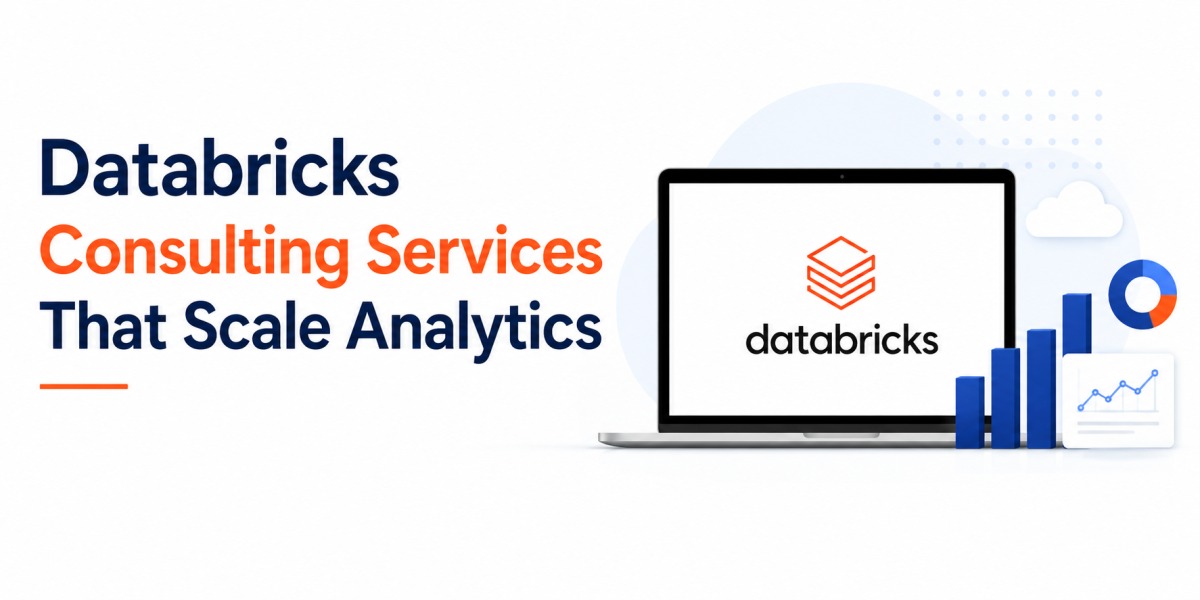
Databricks Consulting Services That Scale Analytics
- By Colin Dann
- 16-07-2026
- Data Science
Most companies don't struggle with data because they lack tools. They struggle because their data platform doesn't behave the way the business expects it to. Pipelines fail quietly. Costs creep up. Teams debate which numbers are right. That's where Databricks consulting services start to matter—not as basic implementation help, but as a way to make a modern data platform work under real operational pressure.
When Data Platforms Start Failing Quietly
Data platforms rarely break in obvious ways. They slow down. Jobs get more expensive. Pipelines become fragile. And suddenly the promise of near-real-time analytics and AI feels far away.
For many teams using Databricks, this is the point where a hard truth shows up. The technology itself isn't the bottleneck. Design choices, governance gaps, and operating habits usually are.
That's when Databricks consulting services tend to enter the picture.
Why Databricks Alone Isn't the Finish Line
Databricks brings data engineering, analytics, and machine learning into one environment. On paper, that convergence simplifies things.
In practice, it introduces tradeoffs. Performance versus cost. Autonomy versus governance. Speed versus stability.
Databricks consulting services focus less on getting the platform running and more on making sure it holds up once real workloads hit production.
I once heard a data leader summarize it perfectly: "The platform worked. Our operating model didn't." That distinction shows up more often than teams expect.
What Databricks Consulting Services Actually Include
Despite the name, consulting here is rarely just advice. It's hands-on redesign of how data work happens.
Platform architecture and environment design
Workspace layout, cluster strategy, job orchestration, and storage design shape both reliability and cost. Early shortcuts compound quickly. Consulting helps teams correct those foundations before issues scale.
Data engineering and pipeline reliability
Most operational pain lives in pipelines. Incremental loads fail silently. Dependencies are unclear. Error handling varies by team.
Databricks consulting services standardize ingestion patterns, improve orchestration, and add observability so failures surface before users notice. This often means introducing Delta Live Tables for declarative pipeline management, implementing proper checkpointing strategies, and building alerting that distinguishes infrastructure failures from data quality issues. The goal isn't just fixing what's broken — it's building pipelines that communicate clearly when something goes wrong.
Cost management and performance optimization
Databricks scales easily. Spending scales just as fast.
Consultants focus on autoscaling strategies, workload isolation, query optimization, and cost attribution to keep performance predictable and budgets defensible. In practice, this means right-sizing cluster configurations for different workload types, implementing spot instance strategies for non-critical jobs, and building cost dashboards that attribute spending to specific teams or projects. Without this visibility, finance conversations about the data platform become difficult — and the platform becomes a target for cost-cutting rather than a recognized investment.
Governance, security, and access control
As usage grows, governance stops being optional. Who can access which datasets. Under what conditions. With what audit trail.
Consulting helps teams design security models that protect data without blocking productivity. Unity Catalog has changed what's possible in Databricks governance — but implementing it well requires decisions about catalog structure, attribute-based access control, and data classification that affect every downstream user. Getting this right once is significantly better than retrofitting governance onto a platform that's already in wide use.
Enablement and operating alignment
Tools don't create maturity. Teams do.
Databricks consulting services often include defining ownership, workflows, and collaboration patterns so data engineering, analytics, and ML teams don't work against each other. This includes establishing code review processes for pipeline changes, defining environment promotion workflows from development to production, and creating shared standards for documentation and testing that persist after the consultants have left.
When Organizations Usually Need Databricks Consulting Services
Not every Databricks deployment requires outside help. But some signals are hard to ignore.
Jobs are reliable only "most of the time." Costs rise faster than data volume. Different teams report different metrics. Changes feel risky to deploy.
At this stage, the challenge isn't skill. It's discipline, structure, and platform design.
Databricks consulting services step in to restore predictability.
Where Databricks Consulting Delivers the Most Impact
- Large-scale data engineering — high-volume ingestion and transformation pipelines benefit from proven architectural patterns.
- Analytics and BI platforms — business teams need consistent, performant datasets they can trust. Making that data accessible through effective data visualization services turns raw platform output into decisions.
- Machine learning and AI workflows — reliable feature pipelines and reproducible training environments matter more than model choice.
- Shared multi-team environments — as more users join the platform, governance and cost controls become critical.
Build Internally or Work with Databricks Consultants?
Most organizations want long-term ownership of their data platform. The question is how to get there without breaking things along the way.
Internal teams understand business context. External Databricks consulting services bring experience from platforms that already hit—and solved—the same failure modes.
Many teams use consultants to design or refactor the platform, then transfer ownership once operations stabilize.
What rarely works is expecting tooling alone to create maturity.
Risks Teams Often Overlook
- Unclear cost attribution — without visibility, spending becomes difficult to justify.
- Pipeline fragility — small upstream changes can cascade into downstream failures.
- Delayed governance — security added late triggers emergency controls and workarounds.
- Knowledge concentration — when too much expertise lives with a few individuals, progress slows.
Where Databricks Platforms Are Headed
Databricks is becoming central to analytics and AI strategies. Real-time use cases are growing. Data sharing is expanding. AI workloads are moving closer to production systems.
That evolution raises expectations. Reliability, governance, and operability matter more than ever. Databricks consulting services increasingly focus on long-term sustainability, not just successful launches.
The goal isn't simply to run Databricks. It's to trust it.
How to Choose the Right Databricks Consulting Partner
Strong partners ask uncomfortable questions early—about cost controls, ownership, and failure scenarios.
Be cautious if discussions stay focused on features or fast wins. Durable Databricks platforms depend on architecture, governance, and operating discipline.
Closing Thoughts
Databricks consulting services aren't about making the platform smarter. They're about making it dependable.
When done well, teams stop worrying about pipelines and surprise costs. Data becomes something they rely on, not something they double-check.
And when new analytics or AI initiatives emerge, the platform is ready—without another round of emergency fixes.
Author

Colin Dann
This blog is published by Colin Dann.
Recent blog
.jpg)
Role of DEX Development in Decentralized Finance
Technology | 24-09-2026.jpg)
How to Evaluate Outsourced Link Building Without SEO Risk
SEO | 23-09-2026.jpg)
Optimize Salesforce Data Before Deploying AI Agents
Salesforce | 22-09-2026