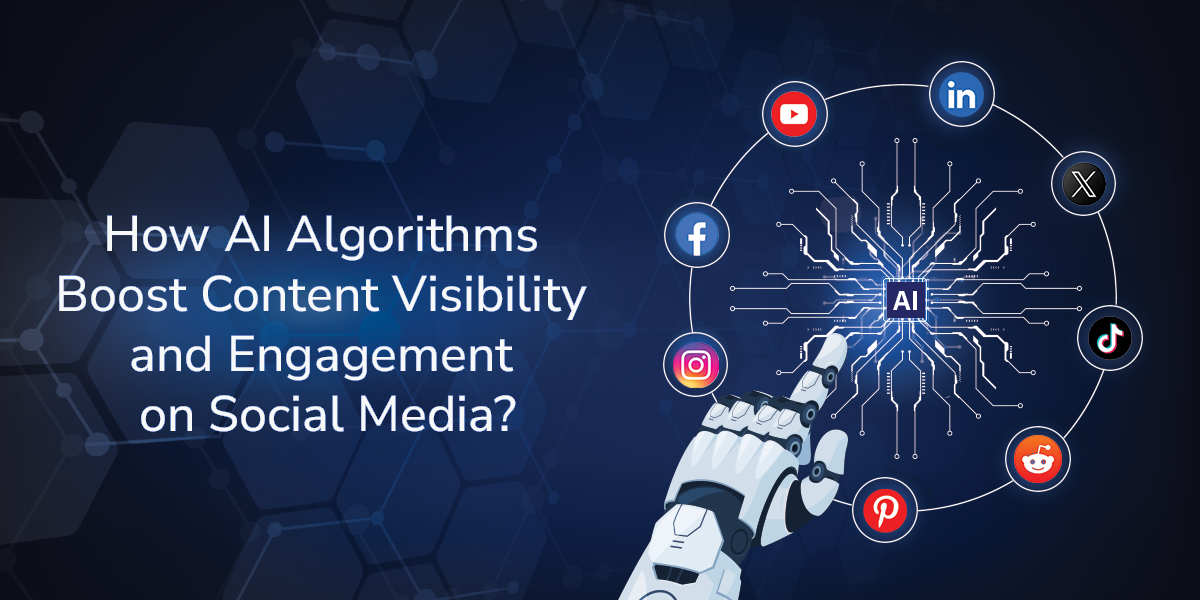
How AI Algorithms Boost Content Visibility And Engagement On Social Media?
- By Michael Bennet
- 28-10-2025
- Artificial Intelligence
you’re scrolling through Instagram. Surprisingly, you come across a post or video related to aesthetic workspace settings or stylish office furniture on your screen.
You may tap like, maybe share, or drop a comment on that post, and then “BOOM!”
From that moment, your entire feed overloads with content about office settings, makeovers, smart DIYs, workspace hacks, and more.
Have you ever wondered what caused this instant shift in your social media feed? It’s nothing but AI algorithms play!
The sudden change in the content feed on your social media is caused by an AI-based algorithm shift. It is termed “Filter bubble” by internet activist Eli Pariser.
AI algorithms analyze users' previous online behaviors, content preferences, interactions, and search histories. With such insights, it reloads the content feeds with highly personalized content that aligns with the audience's interests.
If you’re here to find out how AI algorithms boost content visibility and engagement on social media, then this blog is just for you!
In this article, you’ll explore the role of AI algorithms in influencing social media visibility, its key advantages, how to use them to improve online presence, some real-world examples, future trends, and much more.
Without further delay, let’s begin!
Role of AI Algorithms in Impacting the Social Media Visibility and Engagement
The AI algorithms are slowly making their way into social media marketing. Now, it is the “hot topic” among B2B and B2C businesses worldwide.
According to a recent survey by Sprinklr, 75% of U.S. B2B marketers are employing AI to improve their customer experiences and enhance brand engagement and visibility.
AI algorithms play a pivotal role in simplifying the social media marketing strategies for B2B and B2C brands. Businesses that learn the game of AI algorithms use them smartly to obtain maximum likes, comments, shares, responses, etc., for their posts on social media platforms.
Today, every social media platform has its own integrated AI systems. The AI algorithms use machine learning models, natural language processing (NLP), and data mining technologies to assess the audience’s preferences through likes, shares, comments, sentiment of texts, and interaction with content.
By using such information, AI algorithms produce or recommend the type of content that users like to watch on their content feed. This, in turn, helps brands to gain huge exposure, responses, and engagement for their posts, reels, videos, and more.
For instance, a SaaS based company uses AI algorithms to determine customers’ online behavior and activity. With this information, the company creates and sends personalized ad messages to the customers on various social media platforms, maximizing engagement and conversions.
Furthermore, a recent study by MarketSplash shows that companies that use AI algorithms for managing social media tasks were able to save time and cost, generating an ROI 5X higher.
Key Advantages of AI Algorithms: Amplify Your Social Media Presence
AI algorithms on social media are revolutionizing the way customers interact with brands. At present, it is even more effortless, personalized, and synergistic. Here are several key benefits of using AI:
- Increased Visibility: AI systems and algorithms take advantage of users' insights and recommend the relevant content to the right customers. This gives visibility to the brands.
- Hyper-Personalized Targeting: Having clear insights of customers at hand, the generative AI suggests or curates the hyper-personalized content, resonating with users' wants. It helps you improve the views, likes, and shares for your content on social media.
- Maximized Brand Engagement: AI algorithms on social media use real-time insights of customers' preferences, hyper-personalize their content feeds, and target the right audiences with creative ads. By consistently delivering the relevant content to audiences help companies to achieve huge brand engagement rates on social media.
- Enhanced Customer Experience: AI can make an analysis of human emotions by obtaining crucial insights through comments, reviews, and mentions. This helps marketers to address customers' challenges, concerns, and difficulties. Thereby, businesses can offer an effortless brand experience to their clients.
- Multiplied ROI: The use of AI algorithms helps marketers reduce the usage of resources involved in generic ad targeting. AI predicts and budgets the investment required for personalized marketing. This helps marketers to increase sales and double ROI.
Going Above and Beyond with AI Algorithms: How to Use Them for Improving Social Media Reach
Utilizing AI algorithms enables you to amplify your brand presence on various social media platforms. Since AI algorithms provide real-time data analysis and automation ability. Businesses can automate and optimize their social media presence without any effort.
1) Make Predictive Analysis to Plan Your Ads:
AI-powered algorithms help you understand your customer behaviors. It analyzes past interactions and users’ preferences, determines the patterns, and predicts future actions.
The algorithms segment customer data more accurately, i.e., completely different from the old-school and wider demographic targeting. This allows you to pitch relevant content and messages that perfectly match your targeted audiences, improving visibility and engagement.
2) Create an Engaging Content Based on Trends
AI algorithms help you obtain crucial insights about the ongoing trends and patterns on social media. Additionally, the brands are using AI algorithms to make sentiment analysis of their audiences through search history, likes, and comment section texts.
Having such information at hand, social media professionals create relevant and engaging content that resonates with their audiences on an emotional level. This leads to content virality and popularity, helping brands to drive responses, engagements, and visibility.
4) Automate Your Post Scheduling Times
AI algorithms make an analysis of users' data, such as audience activities, past engagement metrics, content performance, etc. By doing so, brands can able to identify the most suitable time for posting the content to gain maximum responses and engagement rates.
AI algorithms provide real-time insights into the active time of users online through analytical features within social media platforms. This may include such as Facebook analytics, Instagram insights, TikTok Dashboards, and more.
3) Personalize the Content Recommendation
AI algorithms make hyper-personalized content recommendations on social media feeds by collecting and analyzing users' data. This may include past online interactions, likes or dislikes of posts, engagement history, and much more.
By successfully gaining such information, the AI algorithms use machine learning models, such as hybrid systems, matrix factorizations, content filtering, collaborative filtering, etc., to recommend the videos, images, posts, and reels that are relevant to the customers.
This process is a never-ending loop where your customers’ interaction with brands will refine future recommendations.
5) Optimize Your Ads with Algorithms
AI algorithms manage the delivery of personalized ads across the most effective channels, formats, and times to the targeted audiences. It makes an analysis of the costs involved for making high-performing ads and allocates the budget accordingly.
AI algorithms integrated in the social media ads provide clear insights on metrics and suggest the necessary changes required to optimize the strategy. Also, it makes a competitive analysis, where you can gain insights into their creative strategies, ad expenses, and messaging patterns.
With such information, brands can utilize it to reimagine their own strategies in a way that generates higher and positive results.
Real World Use Cases of Brands Using AI Algorithms to Boost Visibility and Engagement on Social Media
AI algorithms work behind closed doors. It plays a number of roles, such as enhancing customer experiences, shielding the platform’s regulations, refining social media ads, helping brands reach their audiences, and much more.
Several brands around the world are using AI algorithms to make their social media management simple and efficient. Here are a few of them:
Set to explore? Let’s dive in!
1. Wowcher
Wowcher is one of the largest British e-commerce sites that operates in the UK and Ireland.
The site offers discounted vouchers, exclusive offers, and daily deals to its customers on various products/services, including consumer goods, travelling, electronics, and much more.
The E-commerce business employs AI algorithms to assess consumer insights and create hyper-personalized social media posts that are relevant to individual users.
In contrast to traditional or generic content, pitching highly personalized ads helps the retailer to generate higher visibility, engagement rates, responses, conversion rates, etc.
2. Sephora:
Sephora is a conglomerate retail brand that sells beauty and personal care products to consumers globally. The business provides 340 brands with its own label, Sephora Collection.
Sephora has AI-based virtual artists and augmented reality (AR) try-ons, enabling users to virtually try different makeup products and share their digital looks on various social media platforms.
The integrated AI algorithms in Sephora’s in-built application closely monitor the user’s online behaviors and fun activities. Using these insights, Sephora presents its products and services that are frequently used by users in the virtual artistic tool.
Additionally, Sephora creates personalized feeds on their homepage and recommends products based on the users triggered algorithms. By doing so, the company not only generates higher engagement rates but also increases the purchasing volume and even maximum conversions.
3. Starbucks:
Starbucks is a global coffeehouse chain that provides cold and hot beverages. The brand offers AI-powered engines, such as “Deep Brew Platforms” and “AI Barista,” for a simplified customer experience.
Using AI algorithms, these platforms offer personalized product suggestions to customers based on weather analysis.
For example, Starbucks AI Barista recommends hot cappuccino on cold mornings and an iced caramel macchiato on a sunny day to its customers. By doing so, it keeps the customers coming back to the store.
So, next time, when you get a hot vanilla latte recommendation from the Starbucks app after a long, cold walk from your work, that's an AI's suggestion.
Additionally, the AI algorithms integrated on these platforms improve the store’s sales and conversion rates, recommending that customers buy complementary products or services.
4. Netflix
Netflix is an American company that offers subscription-based streaming services of various movies, television series, shows, documentaries, etc., on internet-connected devices.
The platform utilizes AI algorithms and machine learning technologies to assess its customer behavior based on specific criteria. This may include search queries, shows review, previous streaming activities, impressions, and much more.
Netflix uses these insights to predict or suggest shows and movies that align with users preferences in future. By doing so, the platform achieves increased engagements, enhanced customer retentions, and maximized subscription rates.
The Future Trends of AI Algorithms on Social Media
The integrated AI algorithms in various social media platforms will persist in fine-tuning the content preferences. Brands will accomplish this by mining customers data and initiating personalized marketing communication.
Every business across industries will start gaining significant popularity and engagement on social media by using AI algorithms to personalize their audience's content feed.
AI algorithms will become even more spot-on in predicting trends and evaluating users' behaviors on social media platforms. This will allow brands to create a content strategy that perfectly aligns with the future trends and patterns.
In the future, the AI algorithms integrated in social media platforms will provide more preferences to AR (Augmented Reality) and VR (Virtual Reality), transforming the users' experience with content and brands.
Conclusion
To sum it up, the AI algorithms are already playing their role in helping brands and content creators to gain visibility and engagement on social media platforms. However, the real game is in the hands of experts who are proficient in using AI algorithms to work for them.
AI algorithms replace those boring and repetitive tasks, such as customer data analysis, content recommendation, ad targeting, and even content creation.
Unlike the traditional manual ads, which are generic and yield poor brand engagement. The integrated AI algorithms on social media have truly transformed the way of showcasing the right content to the right audiences at the right time.
The real-world examples show the success of several top global brands. It explains how these businesses use AI algorithms to maximize user engagement, achieve seamless customer experience, amplify sales rates, drive customer retention rates, etc.
Achieve a higher visibility for your brand on social media! Utilize the power of AI algorithms in your social media marketing today. Take your company’s growth to great heights!
Author

Michael Bennet
Michael Bennet is a marketing specialist at Avention Media. He works on various B2B marketing strategies, helping businesses to reach the right audience and get better results. He enjoys writing, learning the latest marketing trends, and exploring smart ways to help brands grow.
Recent blog
.jpg)
Role of DEX Development in Decentralized Finance
Technology | 24-09-2026.jpg)
How to Evaluate Outsourced Link Building Without SEO Risk
SEO | 23-09-2026.jpg)
Optimize Salesforce Data Before Deploying AI Agents
Salesforce | 22-09-2026