
AI-Driven Mobile App Development : What CEOs and Tech Leaders Must Know to Stay Ahead in 2025
- By Sneha B
- 11-07-2025
- Artificial Intelligence
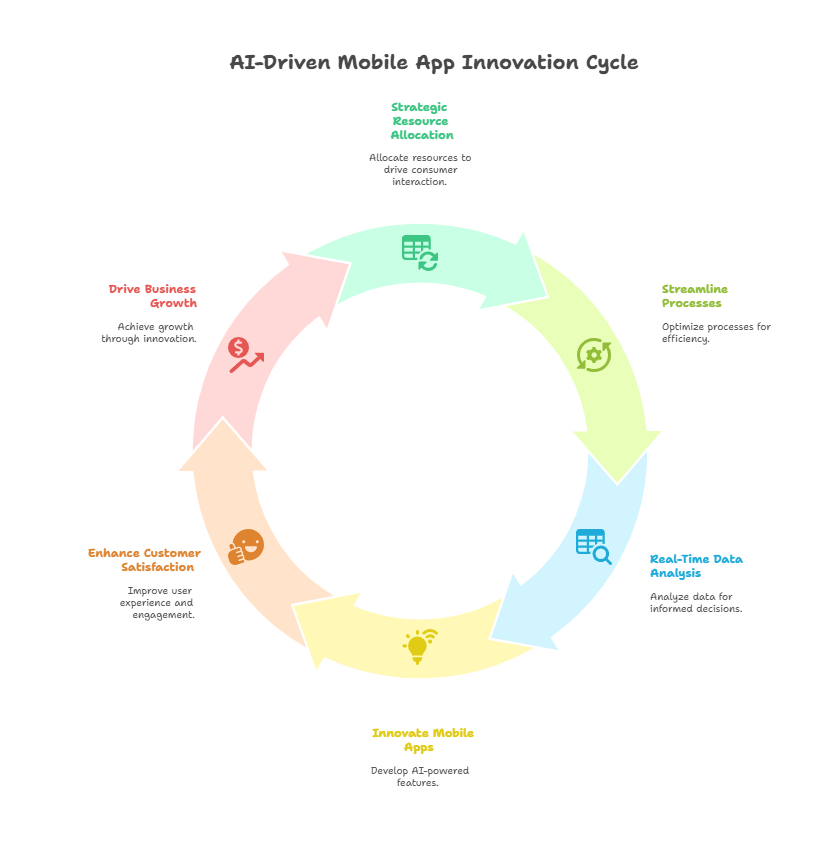
In 2025, innovation are the key in business success, and mobile applications are staying at the center of this shift. Nowadays, with strategic resources driving consumer interaction, streamline processes, provide real-time data for astute decision makers.
Businesses fail to innovate at risk because some industries are changing quickly and consumer expectations are moving forward. Here are some tips for CEOs and tech leaders on how we can lead mobile apps by adopting AI-powered innovation. Not lag—your sector
Why Mobile App Innovation Is Mission-Critical in 2025
In 2025, mobile app development are moving ahead more than ever digital storefronts do, they are an intelligent ecosystems which drive growth, efficiency and customer satisfaction. Across industries like retail, healthcare, logistics, and finance, many apps are the primary channel of engagement and a core component of every business.
Here’s why staying ahead in mobile app innovation is no longer optional—it's mission-critical:
1. Faster Time to Market
Modern mobile frameworks & AI-powered development tools are improving development cycle productivity. Businesses are leveraging low-code platforms, cross-platform frameworks, and automated testing to launch apps in a few weeks instead of months. This allows the industry to respond quickly to market demands, experiment with new technologies, and stay ahead of market competition.
2. Boosted Employee Productivity
Internal business apps are transforming for employees to showcase their work & performance, from field service tracking to remote diagnostics and mobile CRM access. Mobile-first tools can improve communication, reduce manual workflows, and enable real-time decision-making, this is for completely for hybrid and remote teams.
3. Higher Customer Satisfaction and Retention
Today’s users expect personalized, intuitive, and personalized mobile experiences. AI and ML can enable hyper-personalization, predictive suggestions, and 24/7 support via in-app chatbots. Companies deliver seamless mobile experiences see higher engagement, lower churn, & stronger brand loyalty.
4. Scalable Digital Ecosystems
Businesses are building mobile apps not as linked toold, but as part of a broader & connected ecosystem, integrated with CRM, ERP, analytics, and cloud infrastrurcure. This architecture supports growth, facilitates data-driven insights, and helps in integration of technologies like AR/VR, blockchain, and IoT.
The Rise of AI and Automation in Mobile Apps
From highly customised suggestions to automated customer service, artificial intelligence has been at the heart of mobile apps from the ground up. AI solutions help businesses achieve strategic goals while reducing manual labour.
Typical uses of AI in mobile apps include:
- In only a few seconds, intelligent chatbots can respond to hundreds of requests.
- Predictive analytics predicts how users will behave.
- Operational hours are saved by workflow automation.
Many businesses redirect talent and resources towards innovation by automating repetitive operations.
Key Trends Driving Mobile App Development in 2025
Let's talk about the key developments in mobile app development that are influencing the business sectors.
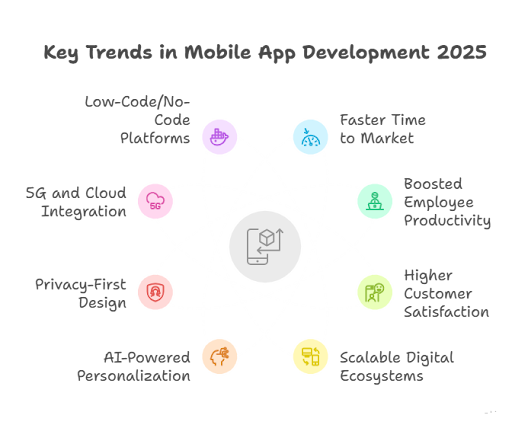
1. AI-Powered Personalisation
Apps can customise offerings, content, and user experiences for every individual thanks to real-time data collecting.
2. Privacy-First Design
Businesses must give safe, compliant architectures top priority in light of the heightened data laws, including GDPR and HIPAA.
3. 5G and Cloud Integration
Cloud-based technologies and fast connectivity result in lower latency and continuous performance.
4. Low-Code/No-Code Platforms
Give non-technical teams the tools they need to create internal apps fast.hence decreasing reliance on artificial cycles.
How U.S. Enterprises Are Leading the Way
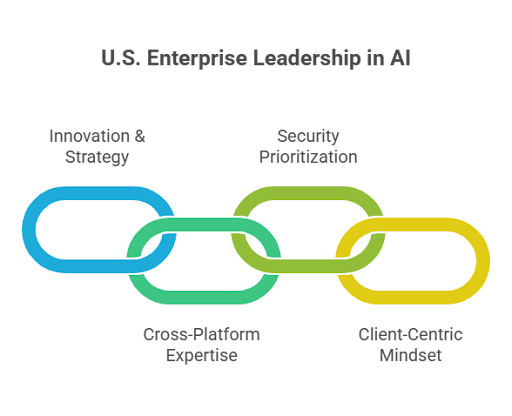
Many US enterprises are setting global standards in AI-driven mobile app development, combining innovation with strategy. Making them apart is not just their adoption of advanced technologies but their expertise, focusing on cross-platform experiences, prioritization of security, and client-centric mindset.
- Starbucks uses artificial intelligence (AI) for analyzing past purchases & sending tailored promotions through its app. This helps in showcasing not only their innovation in AI but also their strategies for user engagement.
- Delta Airlines enhances traveler experience with real-time flight updates & predictive customer support via its app. The airline demonstrates deep expertise in the integration of mobile solutions that prioritize performance, security, & reliability.
- Walmart leverages app-based automation for tracking customer behavior, managing inventory, and streamlining supply chains. Their investment in cross-platform mobile development helps in consistent & seamless experiences across devices with quality assurance & data security.
These businesses serve as evidence that mobile apps using AI boost productivity, customer loyalty, and brand recognition.
The Real Business Impact: Retention and Growth
1. Engagement drives retention
Personalisation is paramount: AI- and ML-driven apps make things possible by tailoring content and offering recommendations to individual user preferences and behaviour, boosting relevance and encouraging engagement.
- Targeted communications matter: Push alerts, in-app messaging, and email campaigns assist customers when used strategically and personally, reminding them of value and promoting recurring use.
- Gamification builds habits: Integrating game features like points, badges, streaks, and apps becomes entertaining & improves progress and achievement.
- Seamless onboarding sets the stage: A smooth and easy onboarding experience, possibly using AI for guiding users, also helps them understand the long-term value.
2. Retention fuels growth and revenue
- Cost-effectiveness of retention: It is nearly less expensive to retain existing users than to acquire new ones. As per research, improving retention by just 5% boosts profit by 25 to 95%.
- Increased customer lifetime value (CLTV): Long-term revenue streams are produced by loyal customers who spend more time and are open to new offerings.
- Boosted sales and conversions: More conversions can be achieved by apps that offer individualised experiences and expedited checkout procedures.
- Stronger brand advocacy and referrals: Devoted users who feel appreciated are more likely to recommend the app to their networks, promoting organic growth through favourable word of mouth.
- Valuable data and insights: App features and tactics can be optimised with the help of the abundance of data generated by retained users about their preferences & behaviours.
3. Technology's role in driving retention and growth
By 2025, advanced technologies like AI, machine learning, and automation will play a massive role in boosting user retention and propelling the app-based business growth.
Here’s how:
- Predictive Analytics: Optimises the next best course of action by user behaviour & churn risk.
- Personalisation at Scale: Automates user-specific content, notifications, and loyalty programs customised to each user.
- Real-Time Engagement: Ensures instant communication through tools like WebSockets and push APIs.
- Adaptive UX: Apps modify flows and features based on user intent and behaviour patterns.
- Continuous Optimisation: Real-time feedback and usage data feed product improvements, raising user satisfaction and credibility.
Together, these technologies turn mobile apps into intelligent systems that adapt, engage, and grow alongside the user.
Choosing the Right AI-Driven Mobile App Solution
Let's take a closer look at how to assess the best option for your business.
- Start with the KPIs and company objectives.
- It is necessary to identify user personas and usage patterns.
- Evaluation of integration with current systems is necessary.
Key considerations when choosing a development partner:
- Defining project needs and goals
- Technical expertise and industry experience
- Communication and collaboration
- Development process and methodology
- Cost and budget
- Post-launch support and maintenance
- Security and legal compliance
- Scalability and flexibility
Essential Features in a Next-Gen Enterprise App
In 2025, your business mobile app should have:
- AI Chatbots to enhance client support Around-the-clock
- Robust security and compliance
- Seamless integration and collaboration
- Predictive analytics: spot patterns before they materialise
- Integrating Social Media to Increase Shareability and Reach
- Modular Design: Get ready for emerging technologies like edge computing and AR/VR
Overcoming Challenges: Compliance and Scalability
Enterprise solutions must be:
- Enterprise apps need to comply with the CCPA, GDPR, and HIPAA.
- Made to be scalable for several users.
- Constructed with strong encryption and access controls
- Scale and security cannot be compromised.
Starting Your AI App Journey: A Roadmap for Leaders
Here's a simple step-by-step to get started:
- Establish your KPIs and business objectives.
- Examine your existing IT setup.
- Join forces with an app development company that specialises in AI.
- Introduce a Minimum Viable Product (MVP) first.
- Monitor user behaviour and make scalable iterations.
Budgeting High-Value Projects ($10,000 and Beyond)
When organising a mobile initiative with significant stakes:
- Make the target platforms, feature set, and integrations clear.
- Allocate funds for:
- QA and testing
- Implementation
- Continuous assistance
- Analytics after launch
What a Strategic Consultation Should Deliver
A quality consultation will yield:
- Market research by industry
- Benchmarking for competition
- Recommendations for the tech stack and tools
- Timeline, cost, and roadmap for scalability
- Opportunities for AI improvement based on your domain
Why Now Is the Time to Invest
Early adopters are already benefiting from a three-year ROI of 40%+ (LambdaTest, 2025).
- Advantage of being the first in their fields
- Faster go-to-market and shorter development cycles
- This is your window of opportunity; you don't want to play catch-up thereafter.
Ready to Transform Your Mobile Strategy?
Join the 73% of enterprises already leveraging AI-powered mobile solutions. Our strategic consultation delivers:
- Industry-specific market analysis and competitive benchmarking
- Custom AI implementation roadmap with ROI projections
- Technology stack recommendations and integration planning
- Risk assessment and compliance strategy
Author
.jpg)
Sneha B
Sneha B is a Senior SEO Specialist at Techmango Technology Services Pvt. Ltd. with 6+ years of experience in driving organic growth through result-oriented SEO strategies. She specializes in technical SEO, keyword research, and content optimization to help businesses rank better and grow faster online. Passionate about digital marketing and outreach, she helps brands build strong online visibility.
Recent blog
.jpg)
Role of DEX Development in Decentralized Finance
Technology | 24-09-2026.jpg)
How to Evaluate Outsourced Link Building Without SEO Risk
SEO | 23-09-2026.jpg)
Optimize Salesforce Data Before Deploying AI Agents
Salesforce | 22-09-2026