
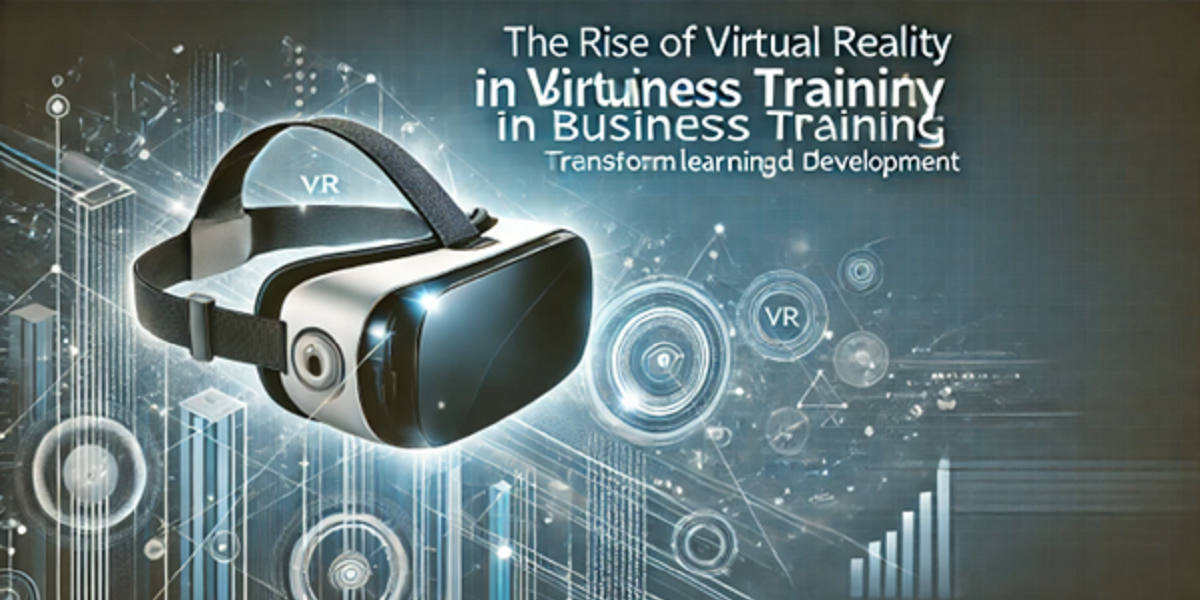
Rise of Virtual Reality in Business Training and Development
- By Sujain Thomas
- 03-12-2024
- Virtual Reality
Virtual reality has emerged as a revolutionary tool in the field of business training and development. It has seen widespread adoption across different industry verticals and organizations have begun to use VR to tap into learning experiences that can be immersive for boosting the skills and productivity levels of their workforce. The scenario of real life whereby there is a simulation of the same makes VR allow trainees to practically train on skills in controlled environments, therefore being more effective in the learning process. This article discusses the surging nature of virtual reality in the training of business persons, its benefits, and how a firm can integrate this concept into their development system.
Introduction to Virtual Reality and Its Role in Business
Virtual reality, or abbreviated to VR, is a simulated experience of reality which can range from close similarities with the real world or even be completely different from reality. It is usually accomplished using headsets or special goggles that produce an all-encompassing environment by letting one interact with 3-dimensional space and objects. Technology involving VR engages more than one sense, such as eyesight and hearing, and could also include touching through equipment that produces tactile sensations. It may lead users through a variety of virtual environments, ranging from highly realistic physical location simulations to fantasy landscapes.
Virtual reality is indeed changing the business world. It transforms how organizations approach training, development, marketing, and engagement with customers. Here are some key areas where VR makes an impact:
- Training and development: VR allows the worker to experience situations about his or her job tasks in a way that is as realistic as possible. Practicing and sharpening his skills, he will develop the best level of performance in a risk-free way. Training through this method is highly useful and helpful in high-risk fields like healthcare and construction where experience is the only way to a good performance.
- Team Collaboration: Virtual reality goes a step ahead to improve team collaboration among distributed teams by creating virtual meeting spaces where employees can easily engage and collaborate within one virtual setting. This further improves communication and teamwork dynamics.
- Customer Engagement: Organizations are using VR to give an immersive marketing experience. For example, for a walk through property, one can use virtual properties in real estate. Retail brands allow the customer to try out the product before he buys it.
- Product Development and Design: With the support of VR, companies can visualize the products in their virtual design phase even before it has actually been produced in the physical world. This ability makes it easier to produce designs and increases the designing process faster with more viable options.
- Performance Analysis: Organizations can collect data during a training session with the help of VR technology and measure the performance of employees. By analyzing these data, organizations can then devise strategies to adjust training programs for better outcomes.
Overall, virtual reality is making business landscapes utterly innovative as it changes the way people learn and work with one another; at the same time, people experience customers in a new manner. The future applications of VR in business are capable of rising as a major technology advancement, thereby being increasingly meaningful for organizations that strive to maintain their position in a dynamic market.
Immersive learning experiences
One of the greatest benefits of using VR in business training is that it immerses people into real life and allows the absorption of knowledge by employees. As opposed to lectures or online courses, VR trains employees through interactive simulations. For example, for a retail company, staff can rehearse their interaction with customers and practice sales techniques without the anxiety of an actual setting. This is a very practical method to remember and understand complex notions well, thereby improving at work.
Moreover, VR training can address certain job roles or sectors. The organizations can make customized scenarios that allow reflection of the difficult task challenges and objectives. As an example, a healthcare organization might use VR in surgical procedures to give medical professionals a safe and realistic setting to hone their skills. In return, when facing real-life situations, these employees feel more confident and better prepared to benefit the organization.
Cost-Effective Solutions
The other significant benefit of using virtual reality in business training is the savings that can be attained. While initial costs toward investment in VR equipment and development seem pretty high, saving in the long term could be immense. Physical spaces and sometimes special equipment are needed for traditional business training; travel expenses can be added, especially when attending a workshop or seminar. Because virtual reality training can be done almost anywhere, it saves on dedicated training rooms or travel costs.
Moreover, VR does not commit errors present during training. In manufacturing or in aviation, for example, the errors of traditional training have serious repercussions. Using VR, employees can commit errors without the consequences those errors would have in the real world. It will become a culture where employees do learn and take time experimenting on what goes and what doesn't. It saves money but encourages innovative solutions.
Encouraging Employee Engagement
Engagement is very important for any training program, and employees engaged through Virtual Reality have been shown to raise their engagement level by a vast percentage compared to conventional training. The immersive nature of Virtual Reality lends itself to keeping the attention of the employee keenly on that subject matter as well as keeping them motivated throughout the learning process. Because they are the ones in charge of the simulation, employees are more likely to absorb as well as apply what they learned to their everyday activities.
Besides achieving engagement, VR training can be a good tool for remote workers. As the number of flexible working arrangements continues to grow, organizations are bound to find new ways of engaging and training a dispersed workforce. Virtual reality offers an opportunity for non-physical remote employees to participate in interactive training sessions. For instance, teams can work in a virtual space, using VR headsets and sitting in virtual infusion chairs, where they can convene, brainstorm, and solve problems as they would in an office.
Future Applications of VR for Business Training
As the technology evolves, business training virtual reality applications will expand. Future implementation can use artificial intelligence for adaptive training environments that can automatically react to the needs of each trainee. Such an amalgamation will result in a much more personalized training by the employees, developing employee enrichment further.
Higher Availability
Virtual reality training is created to meet every learner's needs. As it offers different immersive experiences, VR ensures employees of all different backgrounds and preferences can access the material and engage with it. In fact, there is huge potential for those with disabilities since VR can include alternative means to interact with training scenarios that are difficult or impossible in a more traditional environment.
Immediate Feedback and Assessment
One exciting feature of virtual reality training is that participants can receive prompt feedback. Employees can be monitored immediately while running simulations, so their performance can be assessed at the same moment. There exists here a sense of an immediate feedback loop, through which, learners assess their strengths and weakness, and thus can approach things much faster than with traditional training modes. Companies can also use analytics from such sessions to track the progress of their employees and indicate areas of training that are required for improvement.
Safety Training and Risk Management
Safety training is extremely crucial in sectors such as construction, manufacturing, and health care. Using VR, the employees will be trained for dangerous conditions that they would encounter on the job in a safe way, not putting themselves at risk. Such on-field experience decreases the possibility of accidents and related injuries at work, and this makes a workplace safer.
Cultural Sensitivity and Diversity Training
As businesses expand into other parts of the world, understanding and appreciating cultural differences turns out to be a vital requirement. Virtual reality can play a substantial role in scenarios that require collaboration between employees from different cultural backgrounds, thus developing cultural awareness and sensitivity among them. It would prove highly important for effective teamwork and collaboration between diverse groups, thus developing a more inclusive workplace.
Simulation of Complex Scenarios
VR can simulate very complex scenarios which cannot be run in the real world. For example, someone might find it much easier to be trained on how to manage a crisis or resolve conflicts using VR. In this case, you will be testing employees in very high-pressure situations in controlled environments where they can get experience and prepare them mentally for what is going to happen in reality. They can therefore react more effectively when such circumstances come along in their real environments.
Networking and Collaboration Opportunities
Virtual reality can foster employee networking and collaboration. VR-based solutions can provide virtual spaces for meetings where team members can meet, discuss ideas, and share information in more interactive ways than a traditional video conferencing tool. It fosters teamwork and improves the solutions and project outcomes in most cases.
Better Retention Through Gamification
Gamification in VR training would definitely enhance the degree of attraction and retention of the staff. Since game-like features, for example, rewards, levels, and challenges are introduced, employees will stay motivated and focused in regards to the learning process. The method changes the whole orientation of training into being fun and interactive and pushes information more into the minds of people.
Scalability and Customization
As the organization expands, its training solution must also be scalable. Because the more employees there are, the more virtual reality training there will be in order to add more workers without letting the quality of the learning experience be hindered. Additionally, programs on VR can be adjusted depending on the needs and objectives of a company so that the training will be in line with organizational goals and employee skill development.
From the above, it is clear that all these above-mentioned lead to better comprehensive incorporation of virtual reality in the business training and development scenario, opening doors for more efficient, engaging, and inclusive ways of learning
.
Furthermore, companies are likely to experience improved access to VR training programs and platforms. As many businesses recognize the value of immersive training, there will be strong demand for high-quality content. Industry leaders may emerge that would provide specific VR training solutions to address different needs across industries.
FAQs: Virtual Reality in Business Training
1. What is virtual reality (VR) training?
VR training focuses on a form of immersion technology that can enable employees to go through practice in simulated environments related to their job. It allows for an interactive and hands-on learning experience.
2. Compare VR training with traditional training methods
Unlike lecture-based or online training, with VR training employees will be immersed in realistic simulations, so their experiential learning will increase retention and engagement and improve skill building.
3. Which sectors can adopt VR training?
VR training can be applied universally, including industries such as health, manufacturing, retail, hospitality, and corporate environments. It is notably useful in sectors requiring safety training, customer services, and complex skill development.
4. Is VR training cost-effective?
Naturally, the initial investment in VR technology has to be high, but it may save money in the long term, save money on physical facilities and on travel, besides most importantly minimizing errors made in training which would be very costly afterward.
5. Is VR training organization-specific?
Yes, the VR training can be tailor-made to mirror the unique challenges and goals of an organization. Companies can develop customized scenarios and modules of training according to their specific needs.
6. How does VR training increase employee involvement?
VR training grabs the attention of employees through a much more engaging immersive experience than that of a traditional method of training. In the interactive nature of VR, participants are always highly motivated to engage in their learning process.
7. Benefits of VR safety training?
VR will enable employees to be placed through scenario-based dangerous situations in a controlled and safe environment. Such hands-on practice will help them to learn response protocols without the possibility of injury, thereby avoiding an accident-prone workplace.
8. How does VR training accommodate different learning styles?
The VR training program can include several multimedia experiences that work according to the learning trends of a person, which is either visual, auditory, or even kinaesthetic.
9. How will employee progress be tracked in VR training?
Quite many VR training platforms deliver analytics and reporting, which enables organizations to follow up on employee performance and understand exactly where they are. This information can then be used for improvement areas and measuring the effectiveness of the training delivered.
10. Is VR training everyone's cup of tea?
Although VR training has the potential to help almost everyone, it does not work for all employees, especially when sensitive conditions or motion sensitivity are at play. Organisations should find their specific needs in the workplace prior to the use of VR training.
11. What does the future hold for business regarding VR training?
Advances in technology will see VR training turn out to be a more immersive and customized experience for learners. Integration of AI and machine learning can also resonate well with the adaptability aspect of VR training programs to the needs of individual learners.
These FAQs could help organizations understand the scope of virtual reality for training and development, dispelling most concerns regarding common misunderstandings about the benefits of the technology.
Conclusion
Therefore, the advancement of virtual reality in business training and development is significant because it takes the organization process for employee learning to a completely new level. VR is quite promising regarding revolutionizing how companies best equip their workforce with ready-to-use skills. With businesses continuing to embracing this technology, quality VR training programs aimed at developing skills and promoting a culture of continuous improvement will be where the money is. The bottom line here is that the task lies in preparing the employees for challenges of the modern workplace while maximizing resources-best spent perhaps on what office chair to use or what office furniture to select. Business training finally comes into the future world at the helm of virtual reality.
Author

Sujain Thomas
This blog is published by Sujain Thomas.
Recent blog
.jpg)
Role of DEX Development in Decentralized Finance
Technology | 24-09-2026.jpg)
How to Evaluate Outsourced Link Building Without SEO Risk
SEO | 23-09-2026.jpg)
Optimize Salesforce Data Before Deploying AI Agents
Salesforce | 22-09-2026