
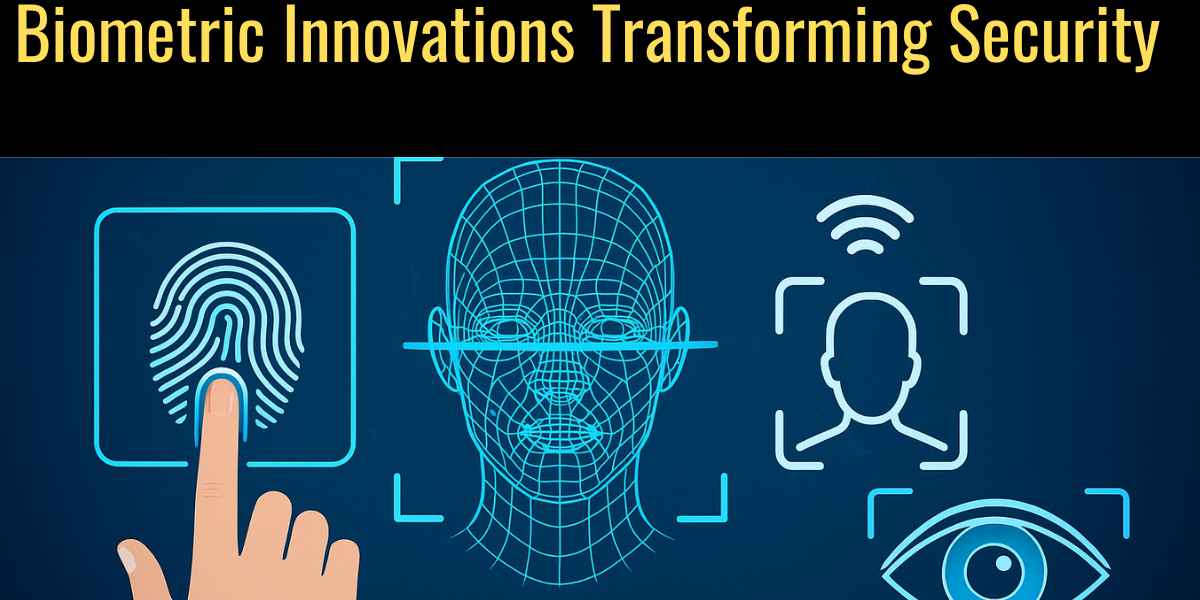
Biometric System Technology Innovations That Are Changing Security Practices Introduction
- By Teja Kurane
- 06-10-2025
- Technology
In the modern technological era, safeguarding information and places has turned into a very difficult chore. In the past, security features like passwords, personal identification numbers, and physical ID cards were the core security and were considered trustworthy. They are all based on the assumption that a person either possesses or knows something, which can always be forgotten, stolen, or shared with others. With the increasing sophistication of cyberattacks and the growing complexity of physical security threats, most organisations are seeking the safest and most reliable methods of identity verification. Thus, as per the analysis of Pristine Market Insights, the biometric system market is expected to grow rapidly due to rising cyberattacks.
This has resulted in a fast development of biometric systems. Biometrics utilise the individual's inherent physiological or behavioural traits associated with methods of identification, like fingerprinting, facial profile identification, voice recognition, or even recognition of walking style. Since ripping off or duplicating these features is difficult, biometric systems usually create less of a risk compared to traditional security methods. Plus, in case a person forgets a password, there is no way a fingerprint can be forgotten, and likewise, an ID card can be lost, but a face cannot.
What makes this field even more fascinating is the emphasis that it is getting from the very nature of its advancement. New technologies are not only making biometric systems quicker and less prone to mistakes but are also making them user-friendly. These upgrades not only mean more security, but they also shift how security is architectured and administered. The methods that are emerging in the light of modern security do not put the emphasis solely on locking down buildings or networks; rather, they rely on integration with the continuity and seamlessness of identity verification.
In this article, we will highlight the advent of all these new biometric identification technologies and their profound impact on global security, tremendously setting the new safety standards for the digital and physical worlds alike.
Overview of Biometric Systems
Biometric systems are security tools that identify individuals by their unique biological or behavioural traits. Biometrics do not ask for something that a person knows (like a password) or something the person has (like an ID card). Biometrics, however, identify someone using the very characteristics of that person. Consequently, it becomes much more difficult for a person to impersonate another.
Biometric traits can be divided into physiological and behavioural. Physiological biometrics are those which come from a person's body and should remain the same for a long time. They are fingerprints, facial structure, iris or retina patterns in the eye, and even the shape of a person’s hand. These are all extremely individual and hardly change, which is why they are very effective for identification over a long period.
Behavioural biometrics are those in which the focus is on a person's habits and movements. The main identifiers could be voice quality and manner of speaking, typing rhythm, walking style (gait), or how the touchscreen is used. Though these traits can vary slightly due to mood or changing surroundings, they still mostly follow the same patterns as they are unique for each person.
Generally, the process of biometric authentication is punctuated in three stages. In the first step, the system collects the biometric data using the sensors or the camera. The next step is feature extraction - the system searches for the most unique details, i.e. the ridges on the finger. The last stage is the matching, where a comparison between the features and the already stored templates is made to identify the person.
Because of the use of personal traits that are very hard to counterfeit, Biometric systems are widely used for security purposes because they allow organizations to verify an individual’s identity using unique biological characteristics such as fingerprints, facial recognition, or iris scans, making them an important component of identity access management tools strategies.
Key Technological Innovations in Biometrics:
-
Multimodal Biometric Systems
On the whole, unimodal biometric systems only use one human feature or characteristic for identification, such as the face or a fingerprint, and multimodal biometric systems use more than one biological feature to identify a person, e.g. face plus finger scanning, or voice plus iris scanning. This kind of solution substantially raises the accuracy of the system and decreases the number of false matches.
In addition, it would become quite difficult for the attackers to get around such a locked system, as they would have to counterfeit not just one but several traits at the same time. Another point of interest is the systems being of a certain nature, as flexible if one sensor fails or transmits data that is unclear, identity can still be verified with the help of the other sensors. Multimodal systems are becoming popular in high-security areas like airports, research labs, and government facilities, where the cost of an identity error is very high.
-
Contactless & Remote Biometrics
One of the main disadvantages is that most of the early biometric devices require direct interaction with the user; for example, the user is required to put their finger on the scanner or press their eye close to an iris reader. Such methods can make the user experience slower and raise hygiene anxiety.
As good as they are, contactless and remote biometrics are a perfect bug fix for these problems. Remote and contactless technologies are the people who can recognise one from afar and still allow spatially-challenged folks to go about their days unquestioned and unbothered. Currently, through the use of contemporary high-resolution cameras and sophisticated image processing methods, a face or an iris pattern can be obtained even from several meters away.
-
AI and Machine Learning Integration
For instance, biometric systems gather a huge variety of complex data, such as very detailed pictures of faces or patterns of the voice waves. Presently, AI and ML have gradually taken over the traditional data processing techniques, which have proven to be more efficient. An artificial intelligence system can digest a massive quantity of data, where it will be able to detect subtle characteristics that may go unnoticed by conventional human methods. Consequently, the situation is leading to improved success rates even when the light isn't quite right, or the angles aren't very good, as well as when background noise is present.
Expanding on this theme, the means of facial recognition given today are struggling with as little as a little help of a face covering, a hat, or glasses. A further use of AI is to help in the reduction of bias by being educated on diversified data from kids, adults, males, females, and different races. The other advantage is that of speed.
AI systems can do the work of processing and comparing the biometric inputs very fast, and thus, identity confirmation takes place instantly. This plays a very important role in security work, like border control or when it comes to providing fast access to personal devices. AI serves as the force behind biometrics & transition from simple pattern completion to a more versatile machine that learns and gets better over time.
How These Innovations Are Changing Security Practices:
-
Transforming Physical Security Practices
The use of biometric technology is going to be the only method to verify identity in the near future. The implementation of biometric security has been redefining the structure of security systems all over the globe. Biometric solutions are changing the entire relationship framework in secure software.
Perimeters were the basis of most security measures in the past. The main method of protection was to construct and install enclosing walls with various physical protections, e.g. locked doors, fences, or network firewalls. Once a person bypassed these perimeters, he was usually trusted without further checks. Biometric security is doing away with the perimeters, and continuous verification of the identity is the key principle of the new system.
-
Strengthening Security Systems
One of the major changes that biometric technology has brought about in physical security is the ability to identify the person through face recognition, iris scans, or touchless fingerprints instead of showing ID cards to guards or typing in door codes. The systems are designed in such a way that people can move through secure areas at a much faster and smoother rate, while still maintaining strict access control, in that access is given only to authorised persons. At the same time, these technologies eliminate the threat of stolen or forged badges.
For example, airports and other busy locations use biometric boarding gates to allow passengers to board without waiting in long queues at the gates and at the same time improve biometric security measures. Biometric security measures are also reshaping the digital world. The passwords of traditional online bank accounts, cloud storage services, and mobile apps are being replaced with biometric logins that include fingerprint sensors or facial scans.
It is almost impossible to imitate human physical traits. Therefore, it is extremely difficult for hackers to break into accounts which are secured using biometrics. Moreover, some systems may also employ behavioural monitoring techniques such as evaluating the user's typing style or the way the phone is being held so as to identify if a session is being hijacked. The security layers these instruments install are imperceptible to the user; thus, if the user is following other security recommendations (e.g., not disclosing passwords)/her overall security habits become stronger.
-
Enhancing Incident Response and Risk Management
Besides, the use of innovative technology has an impact on crisis management. Previously, the law enforcement systems were only able to respond to a security incident that had already been detected, and therefore, they were always late in intervening in the commission of a crime.
On the other hand, modern biometric systems are quick to detect and identify threat behaviours, for example, an unpermitted person trying to use a different account or badge holder. The security teams can take immediate action by, for instance, halting access or triggering alerts. Covering the time interval between threat detection and action is one of the advantages of this pre-emptive style of defence, and thus, the amount of damage the attackers can do is minimised.
-
Growing Real-World Adoption of Biometric Systems
Moreover, there are real-world adoption trends which are clearly visible. Governments have introduced and use biometric passports and national ID programs. Universities have implemented facial recognition for secure exam check-ins. The attendance systems used in offices are biometric, and these systems stop "buddy punching", a behaviour where one worker does the clock-in for another. These things are clear indicators of the transition of biometric technology from luxurious, extremely secure environments to normal daily life. With this development, the security relying on identification becomes the new base for the safety of both physical and digital spheres.
Regulatory Considerations
The biometric data of a person is so intimate that it cannot be compared with passwords, which are easy to reset. If a hacker can obtain the pattern of your fingerprint or your face data, you are going to face identity theft problems forever. Facilities that keep biometric records of millions of people in large databases are the pot of gold for criminals who want to rob them. One data breach can make the most sensitive information of many people available to malicious actors simultaneously, and that can lead to consequences that last for a long time.
Along with privacy, politics, and technology, biometrics also bring a truckload of ethical issues. The ethical issues accompanying biometric technologies are just as significant. For example, many biometric devices clandestinely gather data without notifying the subjects, but they can also feel intrusive if people do not comprehend it fully.
The use of facial recognition cameras in public spaces can track the movements of people who have not given their consent to the practice, thereby generating anxieties over the possibility of being watched all the time. The problem of bias is the other side of the coin: should the system be educated largely by data from certain age groups or ethnicities, it may result in numerous inaccuracies when it comes to others. The mistakes have the potential to bring about discrimination in areas like, for example, access to services being denied due to the error, or even innocent individuals flagged as potential culprits.
These risks are among the reasons why several areas have enacted legislation and norms that govern the use of biometric data. One example is the EU's GDPR (General Data Protection Regulation), which obliges firms to gather biometrics only after the clear permission of the users and also to do so by implementing robust security measures. On the other hand, the California Consumer Privacy Act (CCPA) grants consumers the right to learn how their data will be used as well as the right to request its deletion. The international standards endorsed by the likes of ISO are part of the guidelines on how to securely store and access biometric information.
Future Outlook
It is anticipated that biometric security will become more sophisticated to the extent that it can be called advanced in the future. An innovative trend predicting the use of biometrics is DNA-based identification, which is the most accurate way to verify the identity of a person. Currently, it is limited to a few special laboratories; however, in the future, it could be a tool for quick and advanced DNA analysis in high-security situations. Apart from that, brainwave-based biometrics is another growth area in which the activity of the brain is being recorded by sensors and is given as the unique pattern of the brain. The early study indicates that this method might be the most challenging one to forge among fingerprint and facial recognition.
Moreover, security is still on the way toward decentralised identity systems. In a situation where large central databases store biometric data, future systems will probably allow individuals to store their data on their personal devices or in a secure digital wallet. By having more control over the situation, users would be simultaneously able to minimise the chances that a considerable amount of their data will be stolen. In conclusion, biometrics look forward to more precise identification as well as being discreet, mobile, and user-controlled.
Conclusion
Biometric technologies are revolutionising the security field as they are changing the concept of weak passwords and ID cards, and allowing users to use their personal traits for security, which is hard to fake. One of the leading innovations that has a great impact on the transformation of security from barrier-based to identity-based is the employment of multimodal systems, contactless scanning, AI-powered recognition, local data processing, and continuous monitoring.
Not only are these techs revolutionising the speed of safety measures, but they are also altering the very nature of those measures, which, in turn, means they are becoming more effective and accurate, thereby redefining the spaces that exist both physically and digitally. Still, such techs in general involve significant privacy and moral issues, which call for strict laws and public trust. Without a doubt, the forthcoming setups will possess advanced technology, will be more shielded and under user control, thus fundamentally transforming the relationship between identity and security in daily life.
Author

Teja Kurane
Teja Kurane is a research analyst with a keen interest in emerging security technologies. With a focus on biometric systems and their evolving role in safeguarding digital and physical spaces, Teja brings insightful analysis and industry trends to the forefront of tech innovation discussions.
Recent blog
.jpg)
Role of DEX Development in Decentralized Finance
Technology | 24-09-2026.jpg)
How to Evaluate Outsourced Link Building Without SEO Risk
SEO | 23-09-2026.jpg)
Optimize Salesforce Data Before Deploying AI Agents
Salesforce | 22-09-2026