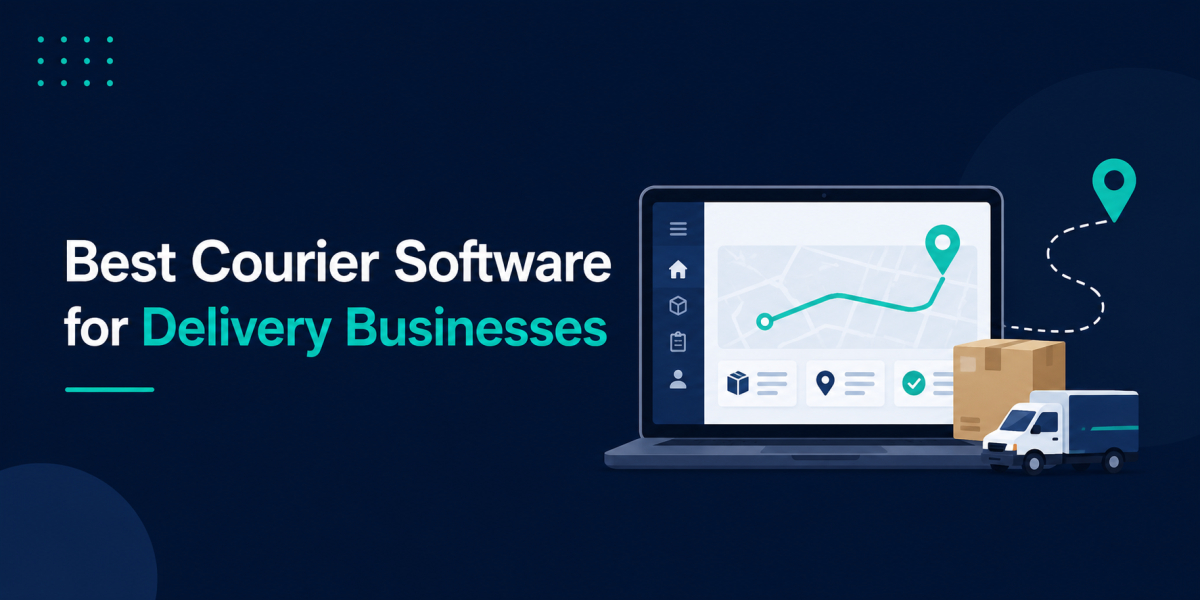
Best Courier Software for Delivery Businesses
- By Martinez
- 21-08-2026
- Software
Delivery businesses run on tight margins. A missed pickup window or a bad route costs real money. The right courier software fixes both problems without adding headcount.
This guide breaks down the platforms worth testing, what each one does well, and where they fall short.
Why Courier Software Matters Now
Route planning by hand doesn't scale past a handful of drivers. Once you add multiple vehicles, delivery windows, and last-minute order changes, a spreadsheet stops working. Dispatch software takes GPS data, delivery windows, and vehicle capacity, then turns them into optimized routes in seconds.
The market reflects that shift. The global last-mile delivery software market hit $3.36 billion in 2026, growing at 11.8?GR year over year, according to Research and Markets. Growth is being driven by same-day delivery demand and tighter customer expectations around real-time tracking.
For a courier company, that means competitors are already automating dispatch, proof of delivery, and customer notifications. Falling behind on software means losing bids on volume contracts, since most enterprise shippers now require live tracking as a baseline requirement.
Best Courier Software for Delivery Businesses
Here are five platforms built for courier and delivery operations, ranked by real-world fit for small and mid-size fleets.
- Spoke. Spoke handles dispatch, route optimization, and driver tracking in one system. It supports same-day and scheduled deliveries, and it connects to existing order management tools through an open API. Dispatchers get a live map view, and drivers get a mobile app with turn-by-turn routing and proof-of-delivery capture. Setup takes days, not months, which matters for smaller courier fleets that can't afford a long onboarding cycle.
- Onfleet. Built for last-mile teams, Onfleet focuses on route optimization and automated customer SMS updates. It handles multi-stop routing well and gives dispatchers a clean dashboard for reassigning jobs mid-route when a driver calls out or traffic shifts.
- Routific. This one puts route optimization first and dispatch second. It's a strong fit for businesses planning hundreds of stops a day with constraints like delivery time windows and vehicle load limits.
- Bringg. Bringg targets enterprise delivery operations. It connects to multiple carriers and fleets at once, so it works well for businesses managing outsourced drivers and in-house drivers under one dispatch view.
- Locus. Locus leans into predictive analytics. It forecasts delivery times using historical traffic and driver performance data, which helps with SLA compliance on high-volume routes where late deliveries carry penalties.
What to Check Before You Buy
Don't pick software based on the demo alone. A demo runs on clean sample data. Your fleet doesn't. Test these things against your own operation before signing anything:
- Route optimization accuracy using your actual delivery density, not a vendor sample dataset
- Driver app performance in low-signal areas, since couriers work basements, warehouses, and rural routes
- API depth, so the software connects to your order source without manual data entry
- Real-time tracking latency, since a five-minute lag breaks customer trust fast
- Support response time during a live outage, not just during the sales call
Run a two-week pilot on one route before switching your whole fleet. Software that looks fast on paper sometimes breaks under real dispatch volume, and you want to find that out before your busiest week, not during it.
Integration Matters More Than Features
A feature-rich platform is useless if it doesn't talk to your existing systems. Before signing a contract, confirm the software connects to your order management system, your accounting software, and your customer communication tools.
Ask for API documentation directly, not a sales summary. If the vendor can't produce it quickly, that's a signal their integration support will be slow too once you're a paying customer and not a prospect.
Common Rollout Mistakes That Sink a Courier Software Switch
Choosing the right platform is only half the job. Plenty of delivery businesses pick a strong tool and still end up worse off in the first month, because the rollout itself was not planned with the same care as the vendor selection. The vendor's sales team will not warn you about this, since their job ends once the contract is signed.
Migrating the Whole Fleet at Once
Switching every driver, every route, and every customer notification over to a new system on the same day is one of the most common ways a rollout goes wrong. If the software behaves differently than expected under real dispatch volume, there is no fallback and no isolated group to compare against. Moving one route or one shift over first, running it alongside the old process for a week or two, gives you a way to catch problems before they touch your whole operation. It also gives drivers on that first route a chance to become informal experts who can help the rest of the fleet once the full switch happens.
Skipping Driver Training Before Go-Live
A dispatch platform is only as good as the drivers using it in the field. If a courier does not know how to mark a failed delivery attempt correctly, or how to capture proof of delivery when a signature is not possible, that gap shows up as bad data in your reporting later. A short, hands-on training session before go-live, covering the handful of actions drivers use every single shift, prevents most of the support tickets that would otherwise show up in week one. Pairing each new driver with someone who already ran a pilot route tends to close this gap faster than a written manual on its own.
How to Calculate ROI Before You Commit
Sticker price is the easiest number to compare between platforms, and also the least useful one on its own. The real cost comparison has to include what the software saves you in fuel, driver time, and avoided penalties, not just the monthly subscription fee. Two platforms priced a few dollars apart per driver can end up with very different total costs once real-world performance is factored in. Build a simple comparison that includes mileage, driver overtime, and any penalty clauses before you sign.
Factor in Fuel and Time Savings
Route optimization typically cuts total mileage by trimming backtracking and grouping stops more sensibly than manual planning ever could. Even a modest reduction in daily mileage compounds fast across a fleet running the same routes five or six days a week. Before you buy, ask a vendor for real customer numbers on mileage or time reduction, not just a generic industry average, since your delivery density and route length will change how much you actually save. Fuel savings alone can offset a meaningful share of the subscription cost within the first few months for a mid-size fleet.
Account for the Hidden Cost of Downtime
A missed SLA or a late delivery on a contract with penalty clauses can wipe out weeks of software savings in a single bad day. When you are comparing platforms, weigh how each one performs under real-world conditions, like a driver going offline in a low-signal warehouse, against how much a missed delivery window actually costs your business. The software that looks slightly more expensive on paper is often cheaper once you price in the deliveries it helps you avoid missing. This is especially true for businesses with enterprise contracts, where a single pattern of late deliveries can put the entire account at risk of non-renewal.
The Bottom Line
Courier software isn't optional anymore. Manual dispatch and spreadsheet routing can't keep pace with same-day delivery expectations or the tracking transparency customers now expect by default.
Start with a platform like Spoke that covers dispatch, routing, and tracking without forcing you into enterprise pricing. Test it against your real delivery volume before committing to a contract. The software that wins isn't the one with the longest feature list. It's the one that keeps your drivers moving and your customers informed.
Author

Martinez
This blog is published by Martinez.
Recent blog
.jpg)
Role of DEX Development in Decentralized Finance
Technology | 24-09-2026.jpg)
How to Evaluate Outsourced Link Building Without SEO Risk
SEO | 23-09-2026.jpg)
Optimize Salesforce Data Before Deploying AI Agents
Salesforce | 22-09-2026