How Predictive Analytics in Salesforce Drives Smarter Business Decisions
- By Michael Wilson
- 22-06-2026
- Salesforce
Sales leaders often have access to vast amounts of raw data but struggle to extract actionable insights from it. While traditional CRM systems record and track every customer interaction, Revenue Operations (RevOps) teams are still frequently caught off guard by unstable sales forecasts, missed expansion opportunities, and unexpected customer churn.
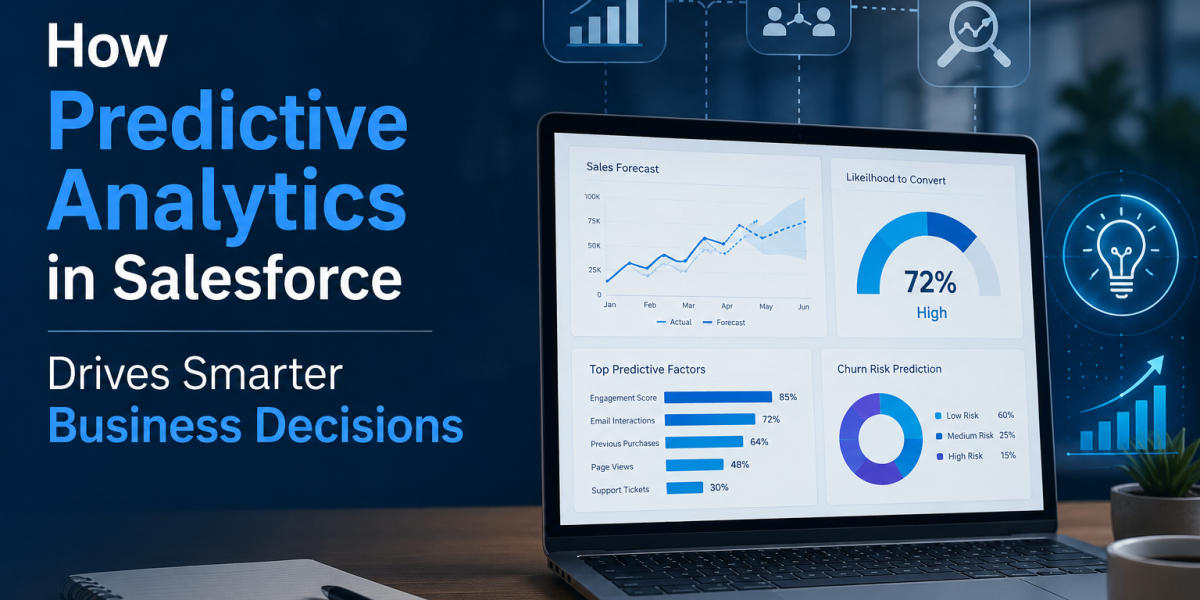
Modern businesses need solutions that move beyond recording historical data and focus on predicting future outcomes. When Salesforce Predictive Analytics becomes part of everyday CRM workflows, it transforms how organizations allocate resources, prioritize opportunities, and improve efficiency. Rather than simply showing what has happened, predictive analytics identifies what is likely to happen next, empowering sales, service, and marketing teams with forward-looking insights.
In this blog, we'll explore ten ways Salesforce Consulting Services combined with predictive analytics help businesses make smarter, faster, and more informed decisions.
10 Ways Salesforce Predictive Analytics is Driving Better Business Decision-Making
1. Lead Scoring with Greater Accuracy
Sales teams operate with limited time and resources, making it essential to identify high-potential prospects. Salesforce Einstein removes guesswork from the process by analyzing historical conversion trends, customer behaviors, and engagement patterns.
By assigning predictive scores to leads, sales representatives can focus their efforts on opportunities most likely to convert while spending less time on low-value prospects. This improves efficiency and increases overall conversion rates.
2. Accurate Revenue Forecasting
Forecasts based solely on individual judgment often vary significantly and lack consistency. Salesforce Predictive Analytics provides more reliable forecasting by uncovering hidden pipeline trends and identifying patterns that may otherwise go unnoticed.
These insights give leadership teams greater visibility into future revenue outcomes, enabling better resource planning, smarter sales capacity allocation, and increased confidence in long-term growth strategies.
3. Proactive Customer Churn Prevention
Customer churn rarely happens without warning signs. However, these indicators are often overlooked until it is too late. Salesforce continuously monitors changes in product usage, support interactions, and purchasing behavior.
When customer activity begins to resemble patterns associated with previous churned accounts, account managers receive early alerts. This proactive approach provides valuable time to intervene, strengthen customer relationships, and improve retention rates.
4. Demand and Inventory Planning
Poor demand forecasting can lead to excess inventory, stock shortages, and costly procurement mistakes. Salesforce Predictive Analytics connects sales pipeline information with historical purchasing trends to project future demand more accurately.
As a result, supply chain and operations teams can make informed decisions about inventory levels, reduce waste, and ensure products are available where and when customers need them.
5. Personalized Customer Engagement
Generic communication often fails to capture customer attention. Personalized experiences, on the other hand, significantly improve engagement and response rates.
Salesforce Predictive Analytics helps businesses understand customer preferences, behaviors, and communication patterns. This enables organizations to deliver tailored messages through preferred channels, creating more meaningful interactions and stronger customer relationships.
6. Smarter Cross-Sell and Upsell Decisions
Growing revenue from existing customers is often more cost-effective than acquiring new ones. Salesforce analyzes purchase history, product usage, and customer behavior to identify the best opportunities for cross-selling and upselling.
By leveraging these insights, businesses can recommend relevant products and premium upgrades at the right time, increasing customer value while enhancing the overall customer experience.
7. Optimized Sales Territory Management
Managing sales territories effectively is critical for maximizing productivity. Salesforce Predictive Analytics evaluates factors such as market potential, account density, and representative workloads to recommend optimized territory structures.
This balanced approach reduces inefficiencies, ensures fair account distribution, and enables leadership teams to deploy resources where they can generate the greatest impact.
8. Improved Customer Service Resolution
Customer service success is often measured through metrics such as average handle time and first-contact resolution rates. Salesforce Einstein analyzes historical case data to predict incoming issues, recommend solutions, and identify the most suitable service agents.
By streamlining case management and improving resolution efficiency, businesses can enhance customer satisfaction, increase retention, and reduce support costs.
9. Marketing Campaign Performance Prediction
Launching a marketing campaign without understanding its potential performance can result in unnecessary spending and poor outcomes. Salesforce Predictive Analytics evaluates audience characteristics, channel performance history, and previous campaign results before launch.
These predictive insights allow marketing teams to optimize campaign strategies, improve targeting, and allocate budgets toward initiatives with the highest probability of success.
10. Risk Identification in Key Accounts
A small number of strategic accounts often contribute a significant portion of business revenue. Salesforce Predictive Analytics helps organizations monitor these accounts by tracking engagement levels, renewal schedules, and customer satisfaction indicators.
Potential risks can be identified early, allowing teams to address concerns before they escalate. With support from an experienced Salesforce Implementation Partner, businesses can create executive-level dashboards that make account risk monitoring a routine part of decision-making.
Conclusion
Businesses seeking sustainable growth must move beyond analyzing historical data and begin anticipating future opportunities. Salesforce Predictive Analytics empowers organizations to make informed decisions across sales, marketing, customer service, and operations.
Partnering with an experienced Salesforce Consulting Services provider ensures the platform is configured to align with business goals and processes. Certified Salesforce experts help organizations unlock the full value of predictive analytics, enabling teams to work smarter, respond faster, and drive measurable business growth.
Author

Michael Wilson
This blog is published by Michael Wilson.
Recent blog
.jpg)
Role of DEX Development in Decentralized Finance
Technology | 24-09-2026.jpg)
How to Evaluate Outsourced Link Building Without SEO Risk
SEO | 23-09-2026.jpg)
Optimize Salesforce Data Before Deploying AI Agents
Salesforce | 22-09-2026