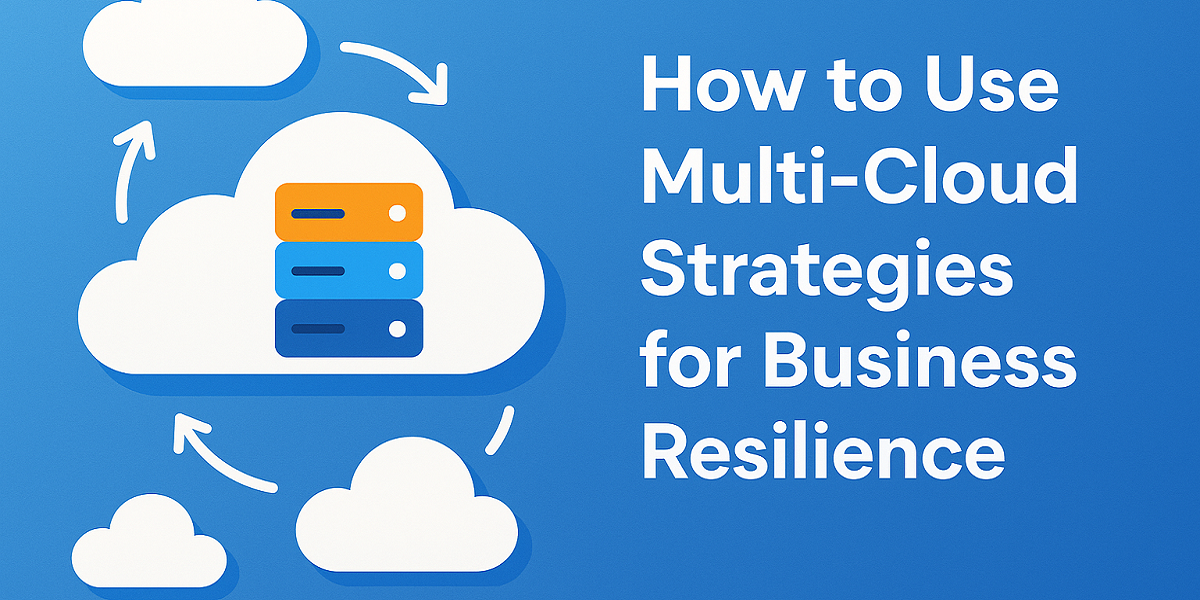
How to Use Multi-Cloud Strategies for Business Resilience
- By Richard Duke
- 16-09-2025
- Cloud Computing
As a matter of fact, resilience is much more than a fashionable term in the modern business world- it is a strategic imperative. A breakdown in operations can occur in just a matter of minutes due to any supply chain shock, cyberattack, or another un-seen outage. Adaptation to uncertainty, all companies are turning to Cloud strategy as the foundation of resilience, and Digital Transformation Strategy, which changes constantly and transforms the process of development.
Another extremely essential aspect of contemporary resiliency is the use of multi-cloud strategies-a purposeful strategy towards the distribution of workloads across various cloud platforms. This article takes a deeper look at how shifting to a Cloud strategy, in the wider context of a Digital Transformation Strategy, can increase business resilience, flexibility, and competitiveness.
1. The Problem Resilience Needs Multi-Cloud Thinking
1.1 Column Failure (Single-Point-of-Failure)
Using one cloud provider can be easier, but this has a word of disaster since it will only result in one weak point of failure. Outages occur at even large providers so the business can be interrupted. The multi-cloud deployment is an important part of a robust Cloud strategy nowadays as a means of risk distribution.
1.2 Harnessing Best-of-Breed Capability
Various cloud platforms may specialize in different spheres so some are known to provide better tools in analytics, others specialize at machine learning, global edge networks or cost effectiveness. The multi-cloud approach will enable you to not only strategize on how you can take advantage of each provider but also the strengths possessed by each provider. This adaptability drives innovation and nimbleness.
1.3 Data Sovereignty/Regulatory requirement
Often, geographic data residency laws may apply to global-scale operations. Multi cloud Cloud strategy meets the jurisdictional requirements that your data remains in its right jurisdiction and yet the services remain global in their uniformity creating strength and endurance both in terms of legal jurisdiction and scope of work.
1.4 Efficiency and Lock-In to Vendor-Lock Avoidance
Lock in is expensive- lack of competition erodes the bargaining power. The strategy of multi-cloud Cloud approach enables organizations to ensure there is price competition and flexibility to allocate workloads wherever cost-efficient, and developing their Digital Transformation Strategy plan in this way makes it economically sustainable.
2. Create a Resilient Multi-Cloud Blueprint
2.1 establish Clear Objectives in Line with Business Goals
Begin with what is important. Question: Is it high availability, disaster recovery, regulatory compliance, performance optimization or acceleration of innovation? Essentially, what this can mean to you is a much more tightly integrated relationship between your multi-cloud Cloud strategy and your enterprise-wide Digital Transformation Strategy.
2.2 Discover workloads and their fit to the cloud
Different applications are not always the same. Classify workloads:
- Mission-critical systems: Demand a large level of availability and critical recovery.
- Burst workloads: Analogues, such as analytics or batch, workloads are suited to this type of elastic scaling in the public clouds.
- Delicate loads: Carry controlled or data-privacy-regulated information-this information may fall under personal or geographically-constricted cloud.
By placing workloads on the most appropriate home in different cloud providers an organisation gains the required resiliency and efficiency.
2.3 select the best fitting cloud platforms and integration tools
Mainstream clouds, e.g. AWS, Azure, GCP, Oracle, and IBM are characterized by different benefits. Resist the fear to do it all, base the decisions on the work involved and requirements of your technology infrastructure.
Implement Cloud strategy frameworks including Kubernetes, Terraform and multi-cloud management tools (e.g., VMware Tanzu, HashiCorp, RightScale) to standardize provisioning across environments, observability and automation.
2.4 Gaming Design To Portability and Interoperability
Employ containerization (Docker) and orchestration (Kubernetes) so that possible workloads could be relocated or redeployed among suppliers with limited turmoil. Specify APIs and data formats carefully in order to facilitate integration and portability. This would embed resilience infiltration into your architecture, to reinforce your Digital Transformation Strategy.
3. Multi-Cloud Without Multi-Chaos
3.1 Standardization of Governance, Policy
Dealing with multiple clouds requires the stability of policies concerning security, compliance, networking, and cost. Standardize policies with IaC, enforce them with automated pipelines and enforce the same governance even when in many environments.
3.2 Consolidated Monitoring, Visibility
Leverage the tooling that unifies data across all the clouds with metrics, logs and traces into common dashboards. The use of such tools as Datadog or New Relic, or open-source Prometheus/Grafana stack, becomes necessary. When there is top-to-bottom visibility, teams can easily be able to identify and respond to issues fast, resilience.
3.3 Automated Failover and Recovery
Specify and exercise failover procedures: what happens when a cloud provider or cloud region fails, will traffic reroute automatically to a different provider or region? Test your resilient failover architecture by ensuring you can use DNS failover (e.g., through Route 53 or Azure Traffic Manager) replicated databases, and readiness drills to ensure that your architecture is resistant to failover.
3.4 Platform Engineering Alignment to DevOps
Cross-cloud pipelines-build, test and deliver in cross-cloud. Utilize CI/CD pipelines which manage deployment across multiple clouds in a consistent way, strengthening your Digital Transformation Strategy further with multi-cloud as an aspect of the engineering cadence.
4. Real-World Use Cases: When Real-World Applications Use Multi-Cloud Resilience
4.1 Financial Services: 24-hour Clarity
Banks are forced to work around the clock- and in many cases, are forced to adhere to rigorous data legislation. The strategy of resilience has primary workload on AWS and backup on Azure. Sensitive information is kept in local or area-specific clouds. The multi-cloud combination helps to support availability and performance as well as compliance.
4.2 Retail & E-Commerce: Booming vs. Local busts
During sales, the e-commerce websites experience very high loads. With a Digital Transformation Strategy employing multi-cloud, traffic can spill over to a fallback environment (e.g. GCP) as thresholds are met--providing reliability when peak demand occurs.
4.3 Manufacturing & IoT: Edge-to-Cloud Continuity
Edge gateways are commonly employed by manufacturers, to push telemetry to regional clouds where it is analyzed and control actions performed. Multi-cloud Cloud strategy avoids having production lines become inactive because a particular provider loses an edge region, since processing operations take place despite a failure.
4.4 Healthcare: Securing such Sensitive Information, Uptime
Medical organizations need to protect their data and provide a steady work of systems without any interruptions. A multi-cloud environment enables them to store PHI (Protected Health Information) in secure, compliant clouds and offload non-PHI analytics to public clouds-without sacrificing either performance or security.
5. definition, extension to KPIs Measuring Success: KPIs Multi-Cloud Resilience
5.1 Availability (Uptime %)
Monitor Uptime at a System Level over clouds. Resilience is reaching 99.99 percent or more and actual system uptime is increased following multi-cloud deployment.
5.2 (RTO) Recovery Time Objectives and (RPO) Recovery Point Objectives
Test and gauge, the speed and extent to which system can recover following outages among clouds. There are benefits of improved performance demonstrated by the use of failover designs.
5.3 Benchmarks of Performance 5.3 Performance Benchmarks
Test latency, throughput and error rates, pre and post workload distribution across clouds. Resilience is displayed by the fact that performance in outage simulations is strong.
5.4 Metrics of Cost Efficiency
Cost per transaction between the clouds. Track budget variance- is multi-cloud strategy something that will increase resilience graciously on cost? Optimize accordingly.
5.5 Compliance Tracking of Governance
Provide the same level of security policies, auditing and logging on every cloud. Follow up on success rate of compliance tasks and remediation time.
6. Traps to be Careful of
6.1 Redtapism with no Obvious Advantages
The issue of spreading workloads onto too many clouds will bring it management complexity and will water down ROI. Avoid cloud sprawl-engage in multi-cloud only where there is strategic advantage to your Cloud strategy.
6.2 Cross-Environment Nonconforming Tooling
Employing all the diverse tools to support each cloud makes it an operationally divided place. Prevent this through the use of common infrastructure and deployment frameworks in order to facilitate congruent management.
6.3 By neglecting Inter-Cloud Network Costs
The inter-cloud data egress can incur sharp expenditures. Consider local workloads, consider inter-cloud data flows, and utilize cost optimized networking (e.g., cloud provider peers or CDN approaches).
6.4 The Non-application of Regular Failover Tests
Failover is not set-and-forget. Failover can fail without frequent testing. To measure the resilience design use Incorporate failure drills into your Digital Transformation Strategy rhythms.
7. Roadmap: Embedding Multi-Cloud into Your Digital Transformation Journey
|
Phase |
Action |
Outcome |
|
Assessment |
Inventory workloads, map risks, define resilience goals |
Clarity on what must be resilient and why. |
|
Design |
Architect multi-cloud layout—workload placement, IP routing, data replication.</span > |
Blueprint aligned with Cloud strategy and business needs |
|
Build |
Implement IaC, containers, cross-cloud pipelines, monitoring stacks |
Multi-cloud infrastructure in place, automated and observable |
|
Test |
Run failover drills, recovery simulations, performance comparisons |
Verified resilience and preparedness. |
|
Deploy |
Move workloads, activate cross-cloud routing, deploy redundancy. |
Live multi-cloud environment operating. |
|
Optimize |
Monitor KPIs, refine governance and costs, enhance pipelines. |
Continuous improvement embedded in Digital Transformation Strategy. |
8. New Trends that influence the future of Multi-Cloud Resilience
As most businesses continue to experiment with multi-cloud, novel technologies and strategies are emanating to make their adoption more resilient and compatible with current objectives of Digital Transformation Strategy. These innovations are already being tested out by the forward-thinking leaders in order to be ahead.
8.1 Cloud Orchestration that Is AI-Driven
The element of artificial intelligence is already an inseparable part of the high level Cloud strategy performance. AI algorithms: can be used to anticipate possible outages or performance degradations using historical trends, real-time feedback, or environmental signals (such as already existing network congestion or risks at data centers). Through the introduction of AI in orchestration tools, enterprises will be able to redistribute workloads between clouds before their problems arise.
E.g., during the holiday sales, an e-commerce business may realize an increased latency on a major cloud region that it uses. AI orchestration process can divert high priority transactions transparently to a backup provider eliminating downtime or loss of revenue.
8.2 Zero-Trust Architectures in the Clouds
Security perimeters are dynamic with workloads spread among many providers. Setting up of a zero-trust model, which involves the belief of none of the users, devices, or services, is now believed to be the best practice applicable to all cloud systems. This trend will supplement Digital Transformation Strategy and Cloud strategy because data and applications are secured irrespective of their hosting place.
The resilience measure in zero-trust integration for outages will guarantee resilience to security breaches which are also as disruptive to business continuity.
8.3 Cross cloud Data Fabric
Enterprises with large clouds are deploying what is sometimes called data fabric architectures which can form a common, virtualized data control plane to enable the control and access to data across clouds. This enables both the portability and consistency of applications being able to read and write to the same datasets irrespective of the provider. It has direct implications on one of the fundamental resilience problems, which is being able to have critical data available and synchronized all the time.
8.4 Sustainability as Multi-Cloud Mumbo Jumbo
Sustainability goals are an impacting factor on cloud strategy. Companies are subcontracting their operations to actors with better usage of renewable energy sources or minimal carbon emission. This is both in alignment with the ESG commitments, and results in resilience in case of a regional energy outage, or energy disruptions due to climate concerns.
9. Leadership Best Practices Embedded Multi-cloud Resilience
Resilient multi-cloud Cloud strategy is 50 percent leadership and organizational culture as it regards technology. The most successful businesses do not merely adopt multi-cloud as a technology-they become integrated into their Digital Transformation Strategy as part of their long-term capability.
9.1 Get Resilience on the Boardroom Agenda
IT teams should not be put into the limits of planning resilience. Senior executives and the board of directors need to appreciate the role of multi-cloud in the development and risk mitigation strategies of the company. However, by featuring it in strategic discourses, it can become easier to make sure that the investment is adequately funded and made a priority.
9.2 Creation of Multi-Cloud Center of Excellence (CoE)
Institute a cross-functional CoE to support best practice consolidations, tool selection, governance yardsticks and dealing relations with the suppliers. It will also be able to enjoy the benefit of faster knowledge sharing, prevention of duplication of effort across departments, and a consistent execution of the Cloud strategy.
9.3 Promote Vendor-Independent Inputs
One of the trappings is having groups of individuals who specialise in the ecosystem of a single cloud provider. Promote detachment and practical experience on a variety of platforms. This does not only promote resilience but widen the capacity of the organization to be innovative and be able to pivot.
9.4 Exercise “Chaos Engineering” Frequently
Chaos engineering is based on the Netflix approach in that random faults or outages can be deliberately injected into the system to see how well it can recover. When coupled with normal operational rhythms, organizations not only gain more confidence in their failover procedures, but they also are able to uncover weak areas before such a situation actually happens.
Test Case Example: The service disruption of a primary cloud can be simulated and the recovery to full functionality on a secondary provider measured after loss of its database service.
9.5 Converge to Budgeting-Resilience Outcomes
Multi-cloud resilience also needs investment in likewise and back-up systems, monitoring tools and extra staff. Instead of regarding downtime resilience as a sunk cost, leaders should associate resilience with business outcomes that are measurable (decreased downtime, accelerated recovery time, and customer satisfaction will all improve the outcomes).
9.6 Make the Stakeholders Know the Value of Resilience
Until something fails, resilience is intangible. Demonstrate to the stakeholders proactively uptime performance reports, positive failover tests, and cost optimisation outcomes. This creates confidence and trust when the customers as well as investors get to see the actual outcome of your Cloud strategy and Digital Transformation Strategy.
Conclusion
In this world of digital business the fast changing environment, resilience is not optional, it is built in. Insightful Cloud strategy, well intertwined into your Digital Transformation Strategy, can help your organization from being disrupted and open up innovation.
Agility, cost advantage and regulatory compliance are becoming achievable by timely selection of workloads, use of portability tools, automating governance and testing fail over stringent processes within business. However, what matters more, is that multi-cloud transforms into a business tool of strategic value, a dynamic nature and evolving one with the ability to drive growth and sustainability, during turbulent times.
You are not only creating systems, but architecting trust. There are multi-clouds in your industry. Becoming multi-cloud tells me you have made a more significant promise: a resilient and agency-looking design. Have your Cloud strategy offer the light to the principles of more resilient, agile enterprises.
Author

Richard Duke
Richard Duke is an AI Strategy consultant with 6+ years of experience in a decade-old digital transformation company. He has assisted various organizations in implementing AI solutions to boost operational efficiency. In his free time, he loves to share his knowledge through blogging.
Recent blog
.jpg)
Role of DEX Development in Decentralized Finance
Technology | 24-09-2026.jpg)
How to Evaluate Outsourced Link Building Without SEO Risk
SEO | 23-09-2026.jpg)
Optimize Salesforce Data Before Deploying AI Agents
Salesforce | 22-09-2026