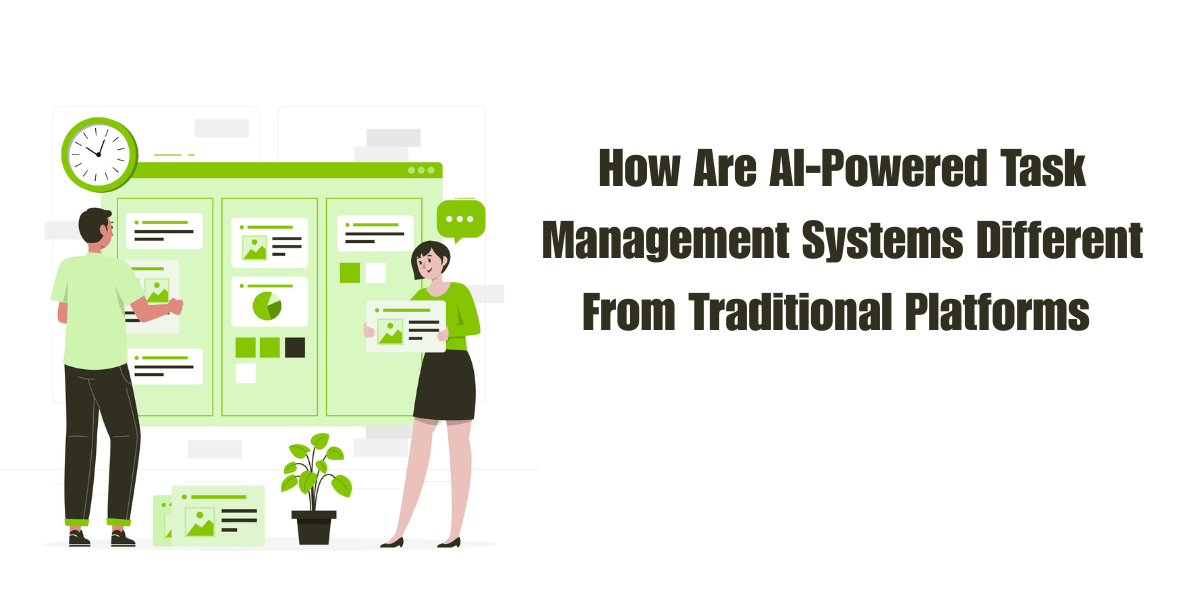
AI-Powered vs Traditional Task Management Platforms
- By Niraj Jagwani
- 21-08-2025
- Blockchain
There’s a fundamental shift underway in how modern enterprises manage work. Not long ago, project coordination was built around lists—task lists, checklists, waiting lists. Project managers spent hours juggling tools, chasing updates, and filling in Gantt charts manually. The goal? To keep projects from falling behind. But somewhere along the way, the pace of business outgrew the systems used to run it.
The problem wasn’t incompetence—it was scale. Teams got larger. Locations got more dispersed. Expectations went through the roof. Suddenly, a tool that was once used to track individual tasks seemed to have a network of cross-functional collaboration, real-time decision-making, and constant strengthening and reprioritization. The days of traditional task management platforms are long gone, built for another era.
Enter the AI-powered task management systems. These platforms are actually more than an upgrade, meaning an entire paradigm shift has happened as to how work gets done. AI systems, in contrast to traditional tools that need users to continually input their information into the operation system, maintain workflows actively. They predict delays before they happen, reassign resources based on capacity, and uncover patterns that might otherwise go unnoticed.
This blog examines the fundamental differences between traditional platforms and their AI-enhanced successors—not just in what they do, but in how they transform team productivity, enterprise decision-making, and operational efficiency.
Traditional Platforms: Organized But Passive
Conventional task management tools were designed to create order and structure. Some tools provide timelines, progress bars, labels, and assignments, ranging from Trello boards to MS Project plans. At their core, these platforms create visibility as to who is doing what and by when.
What's missing here is context. The system would mark those deadlines as late if a developer misses one, but would provide no insight as to why.
Project leads are thus forced to spend more time managing tools than managing actual work. Collaboration is anything but frictionless, usually glued together with emails, spreadsheets, and manual status reporting.
AI-Powered Systems: Intelligent Orchestration
Now, in contrast, a modern AI-based system anticipates inputs rather than merely reacting to them. These platforms learn from historical patterns, consolidate current workflows into a single one, and suggest changes in real-time.
Consider, for instance, a scenario where a product release has been delayed. In a traditional platform, the delay becomes a visible problem. The distraction is a delay in an AI-based system. The system instantly adjusts every downstream task, streamlines internal approval processes, and notifies all impacted stakeholders, with no human intervention in the loop.
That is what makes the development of an AI-enabled task management software development inherently different than other developments. Intelligence is not a bolt-on; it is in the DNA of the platform.
AI does not manage tasks - AI manages work. AI identifies performance patterns, forecasts workload crunches, and allows teams to correct course proactively, without micromanagement. And, by doing so it removes the administrative drag for a team's projects.
Insights Instead of Reports
Traditional systems offer reporting features, such as burndown charts, heat maps, or status dashboards. These help managers visualize what’s happening. But they still rely on the manager to interpret the data and decide the next steps.
AI systems change this dynamic entirely. Not only do they provide the status quo, but they also provide meaning. For example, if the time to complete a task spikes, the system may need to tell you to either redistribute the work or extend the deadline. If the task is consistently late, the system may prompt you to assign that task to a more experienced person or to automate the performance of the task.
These are not arbitrary suggestions; they are based on real-time analytics or historic project data. The system can, over time, understand what types of changes in process and practice lead to successful outcomes. Moving from reporting to resolving is a natural step for AI.
They permit a task manager to migrate from the time-consuming role of firefighter to one that has more aligned thinking! They provide decision support—not just dashboards.
Collaboration Rooted in Context
One of the most underappreciated benefits of AI-powered platforms is how they improve collaboration.
Conventional tools treat collaboration like a bolt-on feature. You can leave comments, tag teammates, or share files. But there’s no intelligence in how that collaboration is managed.
AI systems, on the other hand, understand context. If a task is stuck waiting for input from another department, a tool can prompt that stakeholder to provide the necessary information. Additionally, if team members live in different time zones, the tool can provide reminders and timelines to facilitate effective communication.
Some tools utilize natural language processing to summarize threads for projects, highlight unresolved discussions, or automatically create status updates. This capability helps reduce cognitive load by consolidating project conversations across Slack, email, and project dashboards.
AI doesn’t just help you communicate—it helps you connect meaningfully. For cross-functional teams working under pressure, that’s a significant advantage.
Predictive Planning and Forecasting
Perhaps one of the most valuable capabilities of AI is prediction.
In traditional tools, you schedule tasks, set deadlines, and hope for the best. When things fall behind, you find out too late.
AI systems change that. They can predict the probability of delays based on prior timelines, availability of resources, and the complexity of tasks. They can flag which projects are at risk of going off-track and provide suggestions to minimize that risk. Over time, they learn and refine their models, becoming more accurate in forecasting timelines and improving planning reliability.
For organizations with dozens (if not hundreds) of simultaneous projects, this becomes critical. It increases certainty, helps allocate resources appropriately, and keeps leadership aligned on what is realistic.
One of the reasons why organizations are investing in a task management system is that they can continue beyond managing work; they can manage foresight.
Real-World Use Cases of AI-Powered Task Management
The advantage of AI-based task management is not theory; it is changing the way we manage operations today. For example, in many enterprise software development teams, AI-powered platforms are already tracking sprint velocity in real-time, forecasting story point overruns, and suggesting backlog reprioritizations based on resource availability. They are not continually caught up in daily stand-ups to identify delays—the engineering leads can shift from reactive to strategic.
In consulting environments, where teams are often delivering multiple client deliverables in tight time frames, AI systems that help automate capacity planning are invaluable. The software can recommend changes to staffing or help to reassign tasks to avoid burnout or bottlenecks. Over time, these systems learn, in effect, which types of projects require which skillsets, and they can optimize assignments without a human coordinator having to consider each move.
In supply chain and operations management, AI-enabled task platforms are integrated with inventory data, shipment trackers, and vendor communication channels. If there is a delay in a shipment and it is already in transit, the task system may automatically redraw timelines for projects affected and notify downstream teams.
This is a massive improvement over traditional tools that would require someone to notice the delay and manually realign all dependent work.
These are just a few examples that show how task management software development with AI isn’t just smarter—it’s actively resolving complexities that once needed constant human supervision.
AI in Cross-Functional Program Management
Most modern enterprises don’t operate in silos. They execute programs—collections of related projects that span departments, tools, and goals. Managing these programs in a traditional task management system can be a logistical nightmare.
AI is well-equipped to provide the intelligence required for this complexity. In cross-functional environments, tasks are not just interrelated - they are interdependent. If marketing waits on design, and design waits on legal, one time delay can cause multiple deliverables to be out of sync.
AI systems are especially well-positioned to curate and manage dependencies. They can not only know the interrelationships between tasks, but they can also determine the health of those interrelationships and their movements over time. If legal reviews are always taking longer than originally planned, the system will surface that pattern and adjust all future timelines accordingly.
AI can even find instances in which resource contention is likely to happen. For example, if a key team member is across two departments with multiple high-priority tasks assigned, the system can notify you of the potential conflict and a potential reassignment, or recommend a potential shift in priorities, before the bottleneck does damage.
Even more so, AI-powered platforms can resolve competing priorities. In programmatic situations where marketing needs speed and compliance needs caution, the AI would be able to assess previous projects to suggest the optimal sequencing to achieve both needs without jeopardizing either.
This is the strength of AI, not in the micromanagement of individual tasks, but in orchestrating larger, multi-track efforts with reliability. And that’s something traditional tools were never designed to do.
Scalability That Grows With You
Traditional task platforms hit limits. Now, imagine if the number of users and the number of organizational departments increase, alongside tasks becoming more complicated, you will certainly find it more challenging to manage things effectively.
A system can accommodate 50 or 5,000 users; it will scale. It can automate the delivery of planned projects, provide workflows tailored to specific teams, and enable a certain level of permissioning across the entire organization.
More importantly, AI systems improve with usage. The more projects they manage, the smarter they get. This means that a growing company doesn’t just add users—it adds intelligence.
It’s no surprise that CIOs are increasingly prioritizing AI-centric task management solutions as a pillar of their digital transformation strategy. It’s not about doing the same thing faster—it’s about doing smarter things at scale.
When Not to Use AI for Task Management
Yes, my dear friends, artificial intelligence may boast of offering numerous advantages, but the truth is that AI-enabled platforms are not ideal for every business scenario and context. There are exceptions as well, and you will be more comfortable using traditional tools to carry out your tasks.
First, for very small teams or short-term projects with minimal complexity, the overhead of implementing AI may not be justified. A team of five building a landing page in a week doesn’t need predictive resource allocation—they need speed and simplicity.
Secondly, AI systems need good data to be impactful. If an organization lacks historical task data or a repeatable process, the recommendations for work may be irrelevant or less helpful. In those spaces, it is likely better to stabilize operational discipline before the introduction of AI.
Third, there are industries where automation is tightly regulated. Think defense, aviation, or high-risk healthcare scenarios. It is a particular stage where even the deepest level of intelligent suggestions needs to pass through several levels of thorough human review.
If you notice that the AI platform lacks transparency, then it may become a liability for your organization, rather than being a valuable asset. This is where advanced task management tools consider critical measures like guardrails, audit logs, explainable AI models, and overridable operations. The system should inform, not overrule. It should be your reliable guide and not your master.
Lastly, it is you, the business entrepreneur or CEO, who must make the final decision on whether to deploy AI or not. This pivotal decision must be strategic, where your focus must remain on solving a complex problem and digitizing organizational tasks. When applied recklessly, it adds noise.
The Future of Task Management Software
We can say that the next wave of digitized and innovative task management software is already here, and experts are expecting it to go beyond performing automation and accurate forecasting.
It will collaborate with advanced artificial intelligence agentic solutions, not just recommend action but also independently take charge of low-risk activities such as scheduling meetings, changing deadlines, and generating meeting notes—all without needing explicit approval at every turn.
We will also see the increased use of large language models (LLMs) to allow the team to interface more naturally with platforms.
And as business technology stacks remain API-first, these task systems built on AI will be incorporated into the broader associated workflow—HR, finance, compliance—to take advantage of them to deliver outcomes at the business-function level. Software development for the future of task management will no longer be about individual features, but designing systems to think and behave as smoothly as the associated teamwork.
Conclusion: From Managing Tasks to Mastering Outcomes
The border between legacy task management technology and AI-based technology reaches far beyond UX design or feature lists. It’s fundamentally a mirror of the mentality shift for businesses from rigid control to dynamic orchestration.
AI isn’t helping—it’s increasingly becoming more of a co-pilot, transforming task management from a back-end admin system to a front-line driver of productivity. As industries come to terms with distributed teams, changing priorities, and increasingly compressed delivery windows, smart task systems will be the operating nervous system of high-performing companies.
The winners will be those enterprises that deploy AI judiciously, not only to automate, but to optimize and scale. Those choosing to hang onto legacy, manual approaches will be overtaken by them.
Author

Niraj Jagwani
With a profound experience of more than 15+ years in the IT industry, Niraj Jagwani is the CEO and Co-Founder of TRooTech, a leading custom software development services company since 2014. He is a passionate technology enthusiast and visionary leader dedicated to driving innovation, delivering scalable digital solutions, and empowering businesses through cutting-edge Task Management Software Development strategies. He loves to share the latest trends and insights on software development that empower businesses globally.
Recent blog
.jpg)
Role of DEX Development in Decentralized Finance
Technology | 24-09-2026.jpg)
How to Evaluate Outsourced Link Building Without SEO Risk
SEO | 23-09-2026.jpg)
Optimize Salesforce Data Before Deploying AI Agents
Salesforce | 22-09-2026