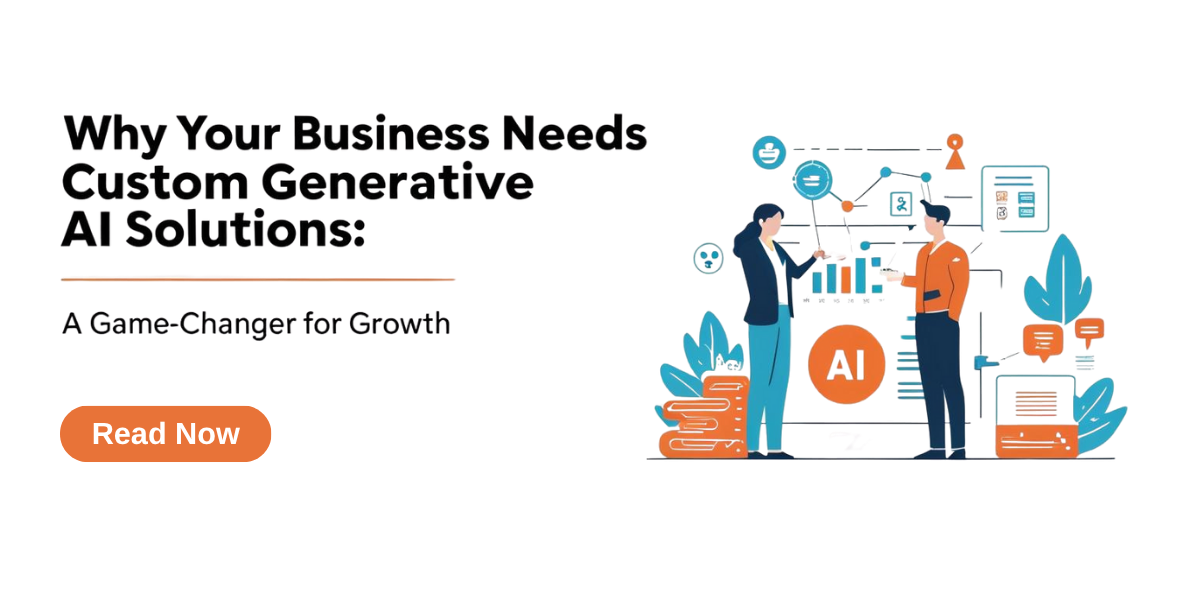
Why Your Business Needs Custom Generative AI Solutions: A Game-Changer for Growth
- By Aastha Tyagi
- 12-08-2025
- Artificial Intelligence
So, AI used to be all about techies and research papers, right? But now, it’s kinda everywhere. Businesses are actually using it to do things faster, smarter, and—let’s be real—make more money. It’s not just a buzzword anymore. It’s actually helping companies get rid of the boring stuff, sift through tons of data, and give customers better, more personalized experiences. And here’s the crazy part: According to PwC, if businesses really use AI the right way, they could boost efficiency by 35% and save a ton of money.
Even smaller businesses are getting in on the action—whether it’s automating customer support or digging into data that makes real-time decisions. The AI market is about to hit half a trillion dollars, so if you don’t start thinking about AI, you could fall behind.
But here's the thing: Custom generative AI. This isn’t just the same old off-the-shelf software. These systems are built just for you. So, the result? Faster decisions, better outcomes, and a real competitive edge.
What Exactly Is Custom Generative AI?
Generative AI refers to algorithms that don’t just analyze data — they create things from it. Think of it like an assistant who doesn’t need a script but can still write one. From product descriptions and emails to customer support messages and even code, these systems are creative by design.
Now imagine giving that assistant private training: showing it your business, your customers, your data. That’s where custom generative AI comes in. Instead of using models trained on open internet data, these AI tools are tailored to your internal knowledge and objectives.
A Few Quick Examples:
- A law firm might train AI to write legal documents using its own case history.
- A bank could predict stock market trends based on proprietary trading patterns.
- A retailer might generate product reviews or ads that match their brand’s tone perfectly.
Why More Companies Are Going Custom
AI’s Role Is Growing — Fast
Every company is expected to move faster while being more efficient. That’s where AI comes in. It takes on data-heavy tasks that humans can’t do as quickly — or at scale. But here's the catch: generic AI tools only get you so far. They're made for everyone, which means they rarely excel at anything specific.
This is exactly why many companies are moving to custom-built models that understand their products, people, and priorities.
Why Not Just Use Off-the-Shelf AI?
Industry-Specific Intelligence
General-purpose AI tools aren’t great at specialized tasks. For example, an AI that’s never seen a medical record can’t suggest treatment plans. But a custom model trained on healthcare-specific data can.
Targeted Solutions
Off-the-shelf tools solve broad problems. Custom AI solves your problems. Want to detect fraudulent transactions in your banking app? Or generate personalized insurance quotes? Custom tools do that.
Adapts as You Grow
Businesses change. Whether it’s adding new services, expanding into new markets, or shifting strategy — your AI needs to keep up. Custom models can be re-trained as your needs evolve.
What Makes Custom Generative AI So Powerful
1. It’s Built for You
Most AI systems try to fit your business into their model. Custom generative AI Solution flips that idea. These tools are designed from the ground up around your needs, data, and goals.
If you’re in fashion retail, you can train a model to write blog posts, style descriptions, or customer emails using your brand’s voice. If you run a shipping business, the model might optimize delivery routes and auto-generate daily logs. The point? One size doesn’t fit all — and with custom AI, it doesn’t have to.
2. Precision and Context
AI accuracy depends on what it's trained on. General models are trained on public datasets — which may not align with your industry. That’s why they struggle with context.
Custom AI, by contrast, can:
- Understand your customer language.
- Recognize industry-specific terms.
- Offer accurate predictions using your historical data.
This is vital in areas like:
- Healthcare: Tailoring recommendations based on patient histories.
- Finance: Recognizing unusual patterns in spending.
- Legal: Drafting contracts with clauses relevant to your firm’s style.
3. It Cuts Down the Repetitive Stuff
Let’s face it — no one enjoys manually preparing reports or copying data between tools. These are exactly the kinds of jobs AI handles best.
You can use custom AI to:
- Write daily performance summaries.
- Auto-generate social media posts.
- Summarize long emails or documents.
With AI doing the repetitive work, your team can focus on strategy and innovation.
4. Smarter Customer Engagement
Today’s customers expect personal attention. AI helps you deliver that, without needing a giant customer support team.
You might use custom AI to:
- Tailor product recommendations.
- Send timely follow-up emails.
- Offer chatbot support that actually understands customer context.
5. It Speeds Up Development
If you build apps or digital tools, generative AI can help you move faster. How?
- Generate clean code snippets.
- Draft technical documents.
- Assist in bug tracking or UI mockup suggestions.
Custom AI tools act like an extra pair of hands for your dev team.
6. More Output for Less Input
Sure, building custom AI isn’t free. But it pays off over time. How?
- Less manual labor.
- Fewer errors.
- More automation.
It helps cut costs while increasing throughput. Think of it as hiring an intern who never sleeps — and keeps getting smarter.
How Custom AI Drives Sustainable Growth
1. Grows With You
Generic AI can hit a wall as your business expands. But custom models can scale — more users, more tasks, more data.
Want to launch in a new region? Add new product lines? Your AI can adapt alongside you.
2. Better Business Decisions
Custom models can surface insights hidden in your data. Think trend forecasts, risk alerts, pricing suggestions — things that help you stay ahead.
Example: An eCommerce platform might use AI to predict when demand will spike. A warehouse can then stock up, instead of scrambling later.
3. You Stand Out From the Crowd
Most businesses today use AI. But few are using it well. With custom AI:
- You can innovate faster.
- Offer better experiences.
- Gain insights your competitors can’t.
It’s not just about using AI — it’s about using it smarter.
How to Get Started With Custom AI: A Step-by-Step Guide
Step 1: Identify Bottlenecks
Begin by carefully analyzing your current workflows and operational processes. Identify where delays, repetitive tasks, or human errors frequently occur. These pain points are where AI can make the most difference. Examples might include slow manual data entry, time-consuming customer service interactions, or inconsistent content generation.
Step 2: Define Use Cases
Once bottlenecks are clear, outline specific use cases where AI can add measurable value. Instead of vague goals, be precise. For example, if your sales team is overwhelmed by lead qualification, AI can score and prioritize leads. If your content team is overburdened, generative AI can draft initial article or email templates. Choose two or three impactful goals to start.
Step 3: Collect Quality Data
AI models need quality input to deliver meaningful results. At this stage, gather your historical and real-time data related to the chosen use cases. Ensure the data is clean, well-organized, and labeled where necessary. Poor data can mislead AI predictions, so this step is crucial for building a strong foundation.
Step 4: Choose the Right Partner
Custom AI development requires both technical skills and domain expertise. Look for partners or vendors with proven experience in your industry and a collaborative development approach. A good partner helps with data preparation, model training, integration into your existing systems, and performance testing.
Step 5: Monitor & Improve
Deployment is not the end — it’s the beginning of continuous improvement. Like a new team member, AI needs oversight and feedback. Set up key performance indicators (KPIs) to track how well the AI performs. Regularly review outputs, gather user feedback, and retrain or fine-tune models to adapt to changing needs or business goals.
Common Myths About Custom AI
- “It’s too expensive.” It’s more cost-efficient than hiring teams for repetitive work.
- “It’s only for big companies.” SMEs can now afford small-scale custom models.
- “It replaces employees.” It frees them to focus on high-value work.
Conclusion
Generative AI isn’t just hype anymore — it’s helping real businesses get real results. But off-the-shelf tools often fall short. The real value lies in AI that understands your unique business.
With custom generative AI, you can:
- Serve your customers better.
- Run operations more efficiently.
- Grow without the usual growing pains.
It’s time to move from basic automation to intelligent transformation.
If you're ready to explore how tailored AI can elevate your business, connect with the team at HashStudioz today. We’ll help you build AI that works the way your business does — smart, specific, and future-ready.
Frequently Asked Questions (FAQs)
1. What’s the difference between generative AI and regular AI?
Okay, quick way to think about it: generative AI is like someone who makes new stuff—writes things, draws, maybe even makes music. Regular AI’s more like the person who looks at a bunch of info and says, “Here’s what’s probably going on.” One builds things, the other makes sense of stuff that’s already there.
2. Can a small business actually swing custom AI?
For sure! You don’t have to go big right away. Lots of small businesses start with simple AI tools for things like handling customer questions or putting together reports. It’s often cheaper than you’d think and really helps day-to-day.
3. How long does it take to set up custom AI?
It depends… If your data’s ready and stuff isn’t too complicated, maybe a month or so. But if it’s tricky, it can take a few months. Usually somewhere between 4 to 12 weeks to get something solid going.
4. Is custom AI safe to use?
It can be safe if it’s done right. Since your data stays inside your own systems, it’s less likely to be exposed than if you’re sending info out to public AI platforms.
5. How do I know if my business is ready for AI?
Well... I mean, if your team’s kinda stuck doing the same boring stuff again and again, or like, if there’s a bunch of data piling up and no one really knows what to do with it—yeah, that’s probably a sign. Also, if it’s taking way too long to make decisions, and things feel kinda slow overall, then yeah, trying out AI might actually help. Doesn’t mean you have to go all in, but could be worth testing out.
Author

Aastha Tyagi
Aastha Tyagi is a technical content writer with a focus on AI and emerging technologies. She enjoys breaking down complex topics into easy-to-understand insights, helping businesses navigate the world of custom AI solutions. Aastha's goal is to make technology accessible and relatable so companies can use it to drive growth and innovation.
Recent blog
.jpg)
Role of DEX Development in Decentralized Finance
Technology | 24-09-2026.jpg)
How to Evaluate Outsourced Link Building Without SEO Risk
SEO | 23-09-2026.jpg)
Optimize Salesforce Data Before Deploying AI Agents
Salesforce | 22-09-2026