
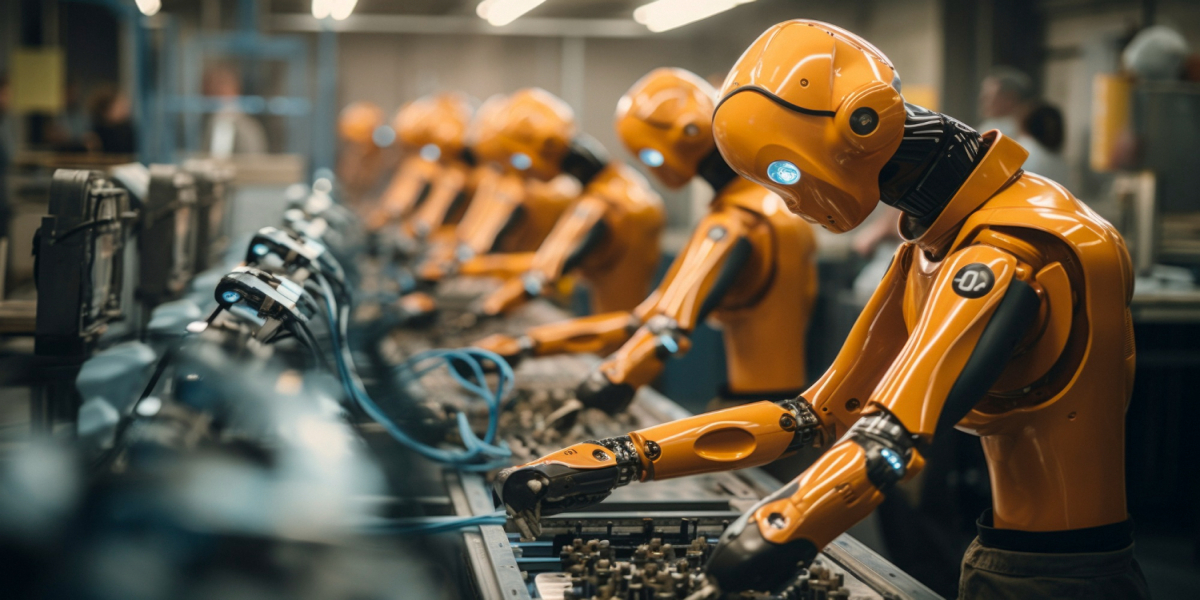
How AI, Robotics, and Automation Are Redefining the Future of Manufacturing
- By Angela Thompson
- 19-09-2025
- Artificial Intelligence
Technology and manufacturing have always moved hand in hand, with innovations in the former driving the growth of the latter. From the invention of steam engines and assembly lines to the adoption of computerised machinery, each wave of technological progress has reshaped how goods are produced. These breakthroughs have enabled manufacturers to reduce costs and deliver products on a scale that would have been unimaginable in earlier eras.
Today, as we move deeper into the age of artificial intelligence (AI), robotics, and automation, manufacturing is once again on the cusp of transformation. Working together under human direction, these innovations are giving rise to smart factories that are more adaptive and productive than ever before. In this article, we’ll explore how AI and robotics and automation are currently being applied in manufacturing and how they’re redefining what the future of the industry could look like.
1. AI-Powered Robotics for Precision and Speed
Robots have long been used in manufacturing, but AI has made them far more capable, enabling them to go beyond preset programming. With machine learning and computer vision, more robots can now adapt to variations and perform tasks that require exceptional accuracy. In electronics and automotive plants, AI-guided robots are already ensuring that delicate assembly, complex welding, and detailed painting are completed quickly and with consistent quality.
AI is also opening new possibilities by helping robots refine their skills through simulated scenarios. For example, companies like BMW use digital twins of their factories, allowing robots to practice assembly or welding thousands of times virtually before deployment on the shop floor, allowing manufacturers to work out potential issues before they can manifest in the real world.
2. Automation for Greater Efficiency
Automation continues to evolve as a key player in modern manufacturing. Systems such as automated conveyors, packaging lines, and quality-control scanners run continuously with minimal oversight, keeping production moving smoothly while maintaining consistent quality.
Beyond speed, automation reduces errors and frees employees from repetitive tasks, allowing them to focus on creative problem-solving and innovation. This shift helps manufacturers achieve higher productivity while using human talent where it adds the most value.
3. Smarter Quality Control with AI
Consistent quality is essential in manufacturing, but traditional inspection methods can be slow and prone to human error. Today, AI powers advanced computer vision systems that detect flaws in real time, from tiny surface defects in electronics to alignment issues in automotive parts. These tools identify irregularities faster and more accurately than the human eye, ensuring products meet strict standards before leaving the factory.
4. Robotics for Safer Workplaces
Safety remains a constant concern in manufacturing, where workers face repetitive strain injuries and hazardous conditions. Robotics helps mitigate these dangers by taking over the dirty work, keeping human workers out of harm’s way. AI adds another layer of protection through intelligent video analytics on the shop floor. These systems can monitor compliance, for instance, detecting when workers are not wearing protective gear, and giving them automatic reminders. Together, these new developments enable manufacturing facilities to become safer environments for humans, even as they become more productive.
5. AI, Robotics, and Automation for Enhanced MRO
Maintenance, Repair, and Operations (MRO) are critical for keeping production lines running smoothly, yet the necessary manual processes can be time-consuming and disruptive. AI helps prevent unplanned downtime by analysing equipment data to predict when servicing is needed, while automation handles task scheduling and robotics performs the physical work. For example, if AI detects early wear on a conveyor motor, a robotic system can carry out inspections or minor adjustments during planned pauses, reducing the impact on production.
Automated lubrication provides another practical example. AI determines optimal intervals, automation initiates the process, and robotic applicators deliver grease precisely where needed. This approach reduces downtime, enhances safety, and allows technicians to focus on higher-value tasks.
6. Optimising Supply Chain Management with AI
AI is also helping manufacturers create more resilient supply chains. It can be leveraged to analyse multiple data points to accurately predict needs and adjust schedules to prevent shortages or overstock. This reduces waste and lowers costs while ensuring that materials and products are always available when needed.
Additionally, logistics planning benefits from AI, which recommends the best shipping routes and detects potential disruptions early. Resources can then be adjusted in real time to maintain smooth operations. When combined with warehouse automation, these systems allow supply chains to respond quickly to changing conditions, keeping businesses competitive even in the face of rapid market changes.
Manufacturing is Being Reimagined in Real Time
The applications discussed above offer just a glimpse of how leading-edge AI, robotics, and automation are transforming manufacturing. New tools and methods are continuously emerging in these fields, unlocking even greater potential for precise and efficient production.
As smart factories become the standard, we’re not only going to see new benchmarks in productivity but also profound changes in human systems. Being at the forefront of today’s tech developments ensures businesses and societies capture these gains responsibly, boosting competitiveness and resilience, all while guaranteeing a better quality of life for all stakeholders.
Author

Angela Thompson
This blog is published by Angela Thompson.
Recent blog
.jpg)
Role of DEX Development in Decentralized Finance
Technology | 24-09-2026.jpg)
How to Evaluate Outsourced Link Building Without SEO Risk
SEO | 23-09-2026.jpg)
Optimize Salesforce Data Before Deploying AI Agents
Salesforce | 22-09-2026