How AI Is Transforming FinTech, Healthcare, and IT Consulting Simultaneously?
- By Eliana Wilson
- 10-04-2026
- Artificial Intelligence
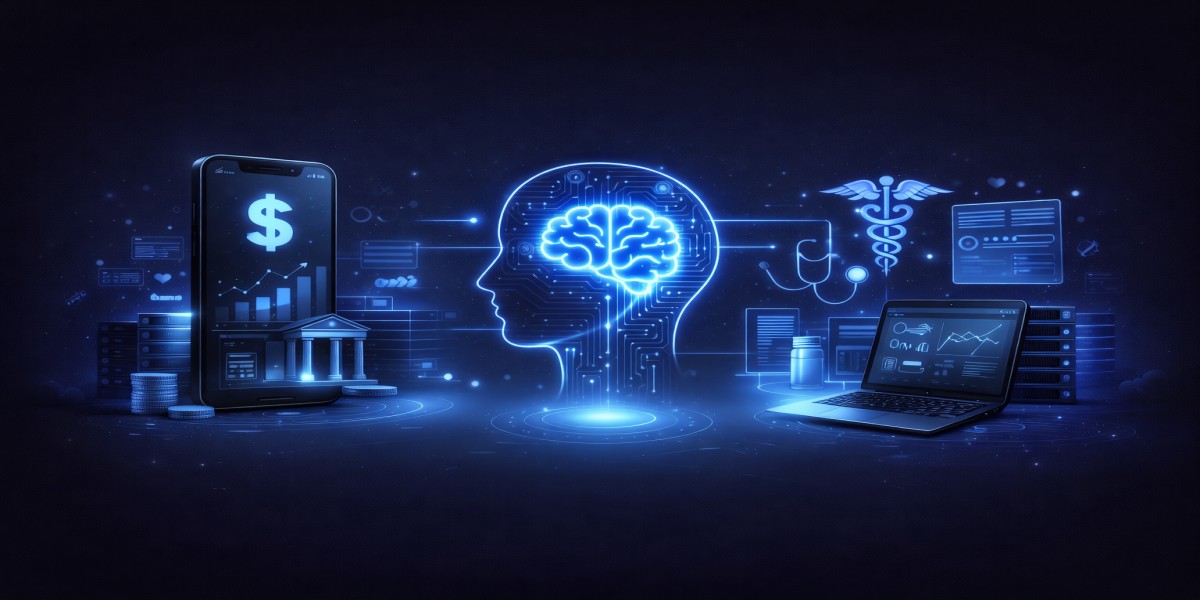
Artificial Intelligence has developed into multiple spheres which extend beyond its original research laboratory and futuristic technology demonstration areas. AI technology generates its most powerful impact through its ability to transform three business sectors which include FinTech and healthcare and IT consulting.
The three sectors that exist in this study exhibit their own unique characteristics. The first branch handles financial matters, while the second branch deals with medical care, and the third branch focuses on business consulting and technology integration. AI functions as the shared intelligent system that connects the three fields by establishing new methods for organizations to reach decisions, handle risks, and provide customer service.
Our research partnership with two industries will enable us to study AI applications which will show us how their digital transformations create upcoming advancements.
The AI Convergence: Why These Three Industries Are Interlinked
The main duty of FinTech and healthcare and IT consulting firms depends on their ability to make choices based on their vast data resources. Financial institutions utilize FinTech solutions to manage their financial risks while they fight against fraudulent activities and track their transaction operations.
- Healthcare facilities use their available resources to conduct diagnostic assessments and create medical treatment approaches while they track patients' health conditions.
- IT consulting provides assistance to businesses through its digital transformation strategy development and infrastructure modernization solutions and its process automation services.
- AI shows its highest performance level when it needs to evaluate and process large data sets during brief time intervals. Organizations in these industries create vast data collections which serve as the foundation for AI to function as their main system that converts raw data into predictive statistical models. The result? A synchronized transformation.
AI in FinTech: Redefining Financial Intelligence
Financial institutions were early adopters of AI, but today the FinTech ecosystem operates with artificial intelligence systems that surpass traditional rule-based systems.
1. Intelligent Fraud Detection
Modern fraud detection systems no longer rely on static rules because AI models demonstrate their ability to learn behavioral patterns through real-time training. The system tracks suspicious activities through its ability to identify irregularities in three different types of data, which include transaction records, device identification, and user location movements and their purchasing patterns. The system has achieved a significant decrease in false positive results, which allows it to correctly identify fraudulent activities through its enhanced detection capabilities that protect essential functions of digital banking.
2. Hyper-Personalized Banking
AI generates personalized financial advice through its analysis of transaction data and assessment of savings patterns and evaluation of lifestyle elements. The system enables banks to handle customer needs through smart budgeting and automatic investment distribution, which AI technology provides as its main function. The shift has created a need for more advanced Fintech app development services, which now require banking platforms to include predictive analytics, AI chatbots, and machine learning algorithms.
3. Algorithmic Lending & Credit Scoring
Traditional credit scoring required access to complete financial records. The AI-powered system utilizes alternative data sources, which consist of transaction history and bill payments and behavioral data, to develop an all-encompassing lending procedure. Banks use the financial system to deliver services to customers without bank accounts, while the system's risk management mechanism safeguards their banking operations.
4. Robo-Advisors and Wealth Automation
AI-powered robo-advisors create and maintain investment portfolios through their ability to monitor current market conditions and user-selected risk levels. The platform provides access to wealth management services, which were previously available only to private wealth advisors. AI app development companies create compliant AI systems which enable various financial applications to operate through their AI solutions development.
AI in Healthcare: From Reactive Care to Predictive Medicine
FinTech companies utilize their technological solutions to minimize financial risks while they enhance their understanding of financial matters. Healthcare organizations implement AI technology to improve their patient health outcomes.
1. Predictive Diagnostics
AI models that studied millions of medical images can identify patterns which humans cannot see. The AI-based diagnostic systems show breakthrough progress in radiology and pathology and cardiology because they enable medical professionals to perform their diagnostic duties. The system helps doctors make better decisions because it provides them with information about their patients' medical conditions which helps them choose optimal treatment methods.
2. Personalized Treatment Plans
The system examines patient medical records and genetic data along with their treatment history to develop personalized treatment recommendations. The system provides customized treatment solutions instead of using a standard approach which treats all patients in the same way. The healthcare organizations must establish partnerships with AI application development firms that possess the required expertise to develop AI systems which meet health data security requirements.
3. Remote Monitoring and Wearable Data
The AI systems study data from remote monitoring devices and wearable devices to detect abnormal patterns in heart rate and blood pressure and glucose level measurements. The system enables health professionals to receive immediate notification when patients need assistance which allows them to manage patient care in an active manner.
The security procedures used by both industries show similarity because both sectors need to protect their data and manage user identities through digital systems.
4. Administrative Automation
AI technology handles all hospital administrative tasks which include appointment scheduling and medical billing procedures. The system improves operational efficiency because IT consulting firms use this approach to implement automation solutions in their business operations.
AI in IT Consulting: The Strategy Enabler
The FinTech and healthcare sectors implement AI technologies in their products and services while IT consulting companies establish AI solutions for various business industries.
1. AI-Driven Digital Transformation Strategy
Consulting firms now use AI readiness assessments and data maturity evaluation and predictive modeling to develop transformation roadmaps. The organization helps businesses comprehend three essential components which include AI use case assessment and AI governance framework development and ethical AI integration methods.
2. Process Automation & Optimization
AI technology combines with Robotic Process Automation (RPA) to streamline department operations by decreasing manual tasks which staff members must complete. AI-powered automation improves efficiency in both financial reconciliation processes and patient record management workflows.
3. AI-Powered Decision Intelligence
Consultants use AI dashboards to monitor operational performance indicators while establishing demands forecasts and assessing potential risk situations. The process enables organizations to move from making decisions based on intuition to utilizing data for their strategic planning activities. Organizations that want these changes to occur need to work with an AI application development firm which can create scalable AI products based on their consulting designs.
The Cross-Industry Impact: Where AI Creates Shared Value
The actual narrative demonstrates how AI technology enables industries to achieve better results through their collaborative development of common solutions.
1. Data Security & Compliance
Healthcare organizations adopt security measures from FinTech which require high data protection standards. IT consultants build AI-powered cyber security systems which protect both sectors.
AI systems for detecting anomalies track data breaches across both financial systems and medical record systems.
2. Predictive Risk Modeling
Both financial institutions and healthcare providers need risk assessment to operate their businesses effectively. AI-powered predictive analytics frameworks developed for credit risk are being adapted for patient risk stratification.
3. Intelligent Chatbots & Virtual Assistants
Conversational AI has reached universal adoption through its use in banking support bots and healthcare triage assistants. Advanced Fintech app development services now embed NLP-powered chat interfaces — a feature also widely used in telehealth applications.
4. Cloud-Based AI Infrastructure
AI models need computing environments which can expand according to their requirements. IT consulting firms create cloud-native designs which enable digital banks and hospital systems to run their AI operations.
The Role of AI Development Expertise
Developing AI systems requires more than machine learning algorithm implementation because it needs the following components
- Data engineering pipelines
- Model training and validation
- Regulatory compliance integration
- Cloud deployment
- Continuous model monitoring
Organizations choose to work with specialized AI app development company partners because these partners possess expertise in both industry-specific challenges and AI system architecture design.
Enterprises that invest in Fintech app development services now demand integrated artificial intelligence functions which they consider essential parts of their software.
Ethical AI: A Shared Responsibility
FinTech and healthcare and consulting services sectors are experiencing ongoing growth of AI adoption which results in more ethical problems.
Bias in Algorithms
AI systems developed from biased training data produce unfair lending outcomes and generate false medical diagnoses.
Transparency & Explain ability
Financial regulators and healthcare authorities increasingly require explainable AI models.
Data Privacy
Organizations that handle sensitive financial and medical data must use advanced encryption and anonymization and governance frameworks. IT consulting firms design responsible AI frameworks which help organizations achieve compliance while they continue to develop innovative solutions.
Economic Impact: AI as a Growth Multiplier
AI systems create new business models while enhancing operational efficiency.
- The following works demonstrate embedded finance through automated investment management platforms and predictive insurance assessment systems which use artificial intelligence technology.
- Artificial intelligence enables researchers to discover new drugs through its use in subscription-based health monitoring and its function in preventive health management system development according to the research work.
- The following work shows how organizations develop artificial intelligence platforms through their use of AI-as-a-Service (AIaaS) solutions and predictive maintenance systems and intelligent automation consulting services.
- The organizations which implement advanced Fintech app development services will build platforms which operate through artificial intelligence.
- The organizations will create platforms which function as digital banks.
The Future: Integrated AI Ecosystems
The upcoming transformation will find its solution through AI ecosystems which require advanced AI technologies that different industries must establish through partnership agreements.
The health insurance platform uses wearable health data to calculate dynamic premium adjustments. The financial wellness application enables users to predict their upcoming medical costs.
The enterprise dashboards display healthcare workforce analytics together with financial performance metrics. The ecosystems require cross-industry partnerships which need advanced AI technologies that an AI app development company with diverse expertise provides.
Challenges That Still Need Solving
The adoption of AI technology encounters multiple obstacles despite the technology's fast expansion.
- The integration of existing systems into new technologies presents the first challenge.
- The workforce lacks sufficient qualified professionals to meet current demand.
- The uncertain regulations create two obstacles for businesses who need to implement their operations.
- The company requires data over three different systems because they keep their information separate.
- IT consulting firms are increasingly creating AI Centers of Excellence to assist businesses in overcoming these challenges.
The current businesses that develop Fintech applications now choose to implement AI-ready modular architectures as their preferred solution.
Conclusion: A Simultaneous Revolution
The implementation of AI in FinTech and healthcare and IT consulting creates a digital ecosystem that operates as a single unified system. Financial institutions use AI systems to optimize their operations because the technology helps them develop superior risk management systems which foster customer trust. AI-based systems in healthcare deliver better patient results through their ability to predict medical outcomes with high accuracy. The strategic innovation tools that AI systems provide IT consulting firms enable these companies to achieve complete business transformation.
The organizations that will lead this decade are not those experimenting with AI casually but those embedding it deeply into their operational DNA. Enterprise organizations need to develop AI-first systems through partnerships with experienced AI application development firms and advanced Fintech application development service providers.
The transformation needs execution because it has become mandatory. The process operates in multiple ways because its parts work together and begin executing their tasks.
Author

Eliana Wilson
This blog is published by Eliana Wilson.
Recent blog
.jpg)
Role of DEX Development in Decentralized Finance
Technology | 24-09-2026.jpg)
How to Evaluate Outsourced Link Building Without SEO Risk
SEO | 23-09-2026.jpg)
Optimize Salesforce Data Before Deploying AI Agents
Salesforce | 22-09-2026